Reading List
The most recent articles from a list of feeds I subscribe to.
Teaching: General case first or special cases first?
A common dilemma while teaching (I’m not only talking about teaching in a school or university; talks and workshops are also teaching), is whether it’s better to first teach some easy special cases and then generalize, or first the general case and then present special cases as merely shortcuts.
I’ve been revisiting this dilemma recently, while preparing the slides for my upcoming regular expressions talks. For example: Regex quantifiers.
1. General rule first, shortcuts after
You can use {m,n} to control how many times the preceding group can repeat (m = minimum, n = maximum). If you omit n (like {m,}) it’s implied to be infinity (=“at least m times”, with no upper bound).
- {m, m} can also be written as
- {0,1} can also be written as ?
- {0,} can also be written as *
- {1,} can also be written as +
Advantages & disadvantages of this approach
- Harder to understand the general rule, so the student might lose interest before moving on to the shortcuts
- After understanding the general rule, all the shortcuts are then trivial.
- If they only remember one thing, it will be the general rule. That’s good.
2. Special cases first, general rule after
- You can add ? after a group to make it optional (it can appear, but it may also not).
- If you don’t care about how many times something appears (if at all), you can use *.
- If you want something to appear at least once, you can use +
- If you want something to be repeated exactly n times, you can use
- If you want to set specific upper and lower bounds, you can use {m,n}. Omit the n for no upper bound.
Advantages & disadvantages of this approach
- Easy to understand the simpler special cases, building up student interest
- More total effort required, as every shortcut seems like a separate new thing until you get to the general rule
- Special cases make it easier to understand the general rule when you get to it
What usually happens
In most cases, educators seem to favor the second approach. In the example of regex quantifiers, pretty much every regex book or talk explains the shortcuts first and the general rule afterwards. In other disciplines, such as Mathematics, I think both approaches are used just as often.
What do you think? Which approach do you find easier to understand? Which approach do you usually employ while teaching?
Teaching: General case first or special cases first?
A common dilemma while teaching (I’m not only talking about teaching in a school or university; talks and workshops are also teaching), is whether it’s better to first teach some easy special cases and then generalize, or first the general case and then present special cases as merely shortcuts.
I’ve been revisiting this dilemma recently, while preparing the slides for my upcoming regular expressions talks. For example: Regex quantifiers.
1. General rule first, shortcuts after
You can use {m,n} to control how many times the preceding group can repeat (m = minimum, n = maximum). If you omit n (like {m,}) it’s implied to be infinity (=“at least m times”, with no upper bound).
- {m, m} can also be written as
- {0,1} can also be written as ?
- {0,} can also be written as *
- {1,} can also be written as +
Advantages & disadvantages of this approach
- Harder to understand the general rule, so the student might lose interest before moving on to the shortcuts
- After understanding the general rule, all the shortcuts are then trivial.
- If they only remember one thing, it will be the general rule. That’s good.
2. Special cases first, general rule after
- You can add ? after a group to make it optional (it can appear, but it may also not).
- If you don’t care about how many times something appears (if at all), you can use *.
- If you want something to appear at least once, you can use +
- If you want something to be repeated exactly n times, you can use
- If you want to set specific upper and lower bounds, you can use {m,n}. Omit the n for no upper bound.
Advantages & disadvantages of this approach
- Easy to understand the simpler special cases, building up student interest
- More total effort required, as every shortcut seems like a separate new thing until you get to the general rule
- Special cases make it easier to understand the general rule when you get to it
What usually happens
In most cases, educators seem to favor the second approach. In the example of regex quantifiers, pretty much every regex book or talk explains the shortcuts first and the general rule afterwards. In other disciplines, such as Mathematics, I think both approaches are used just as often.
What do you think? Which approach do you find easier to understand? Which approach do you usually employ while teaching?
Poll: ¿Is animation-direction a good idea?
¿animation-direction?
Lets assume you have a CSS animation for background-color that goes from a shade of yellow (#cc0) to a shade of blue (#079) and repeats indefinitely. The code could be something like this:
@keyframes color {
  from { background: #cc0 }
  to { background: #079 }
}

div {
  animation: color 3s infinite;
}
If we linearize that animation, the progression over time goes like this (showing 3 iterations):

As you can see, the change from the end state to the beginning state of a new iteration is quite abrupt. You could change your keyframes to mitigate this, but there’s a better way. A property with the name animation-direction gives a degree of control on the direction of the iterations to smooth this out. It also reverses your timing functions, which makes it even smoother.
In early drafts, only the values normal and alternate were allowed. normal results in the behavior described above, whereas alternate flips every other iteration (the 2nd, the 4th, the 6th and so on), resulting in a progression like this (note how the 2nd iteration has been reversed):

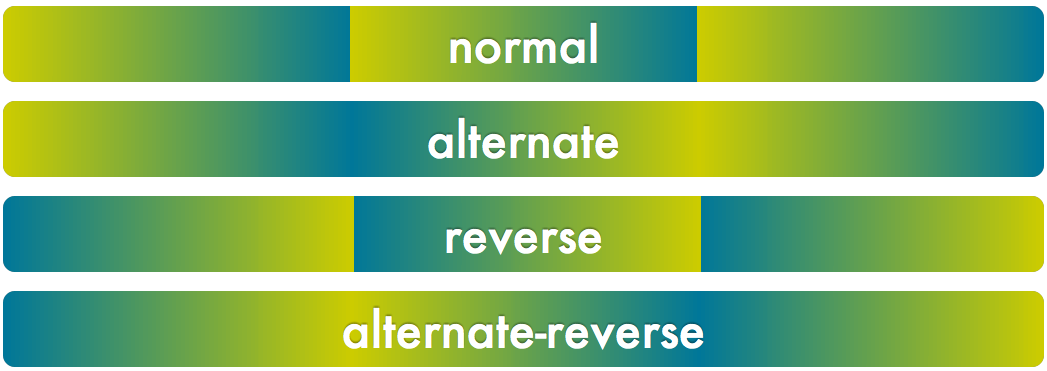
The latest draft also adds two more values: reverse which reverses every iteration and alternate-reverse, which is the combination of both reverse and alternate. Here is a summary of what kind of progression these four values would create for the animation above:
The problem
I was excited to see that reverse and alternate-reverse were finally added to the spec, but something in the syntax just didn’t click. I initially thought the reason was that these four values essentially set 2 toggles:
- ¿Reverse all iterations? yes/no
- ¿Reverse even iterations? yes/no
so it’s pointless cognitive overhead to remember four distinct values. I proposed that they should be split in two keywords instead, which would even result to a simpler grammar too.
The proposal was well received by one of the co-editors of the animations spec (Sylvain Galineau), but there was a dilemma as to whether mixing normal with alternate or reverse would make it easier to learn or more confusing. This is a point where your opinion would be quite useful. Would you expect the following to work, or would you find them confusing?
animation-direction: normal alternate;/* Equivalent to animation-direction: alternate; */animation-direction: alternate normal;/* Equivalent to animation-direction: alternate; */animation-direction: normal reverse;/* Equivalent to animation-direction: reverse; */animation-direction: reverse normal;/* Equivalent to animation-direction: reverse; */
A better (?) idea
At some point, in the middle of writing this blog post (I started it yesterday), while gazing at the graphic above, I had a lightbulb moment. ¡These values are not two toggles! All four of them control one thing: which iterations are reversed:
normalreverses no iterationsreversereverses all iterationsalternatereverses even iterationsalternate-reversereverses odd iterations
The reason it’s so confusing and it took me so long to realize myself, is that the mental model suggested by these keywords is detached from the end result, especially in the case of alternate-reverse. You have to realize that it works as if both alternate and reverse were applied in sequence, so reverse first reverses all iterations and then alternate reverses the even ones. Even iterations are reversed twice, and are therefore equivalent to the original direction. This leaves the odd ones as being reversed. It’s basically a double negative, making it hard to visualize and understand.
I thought that a property that would reflect this in a much more straightforward way, would be animation-reverse (or animation-iteration-reverse), accepting the following values:
none(equivalent to animation-direction: normal)all(equivalent to animation-direction: reverse)even(equivalent to animation-direction: alternate)odd(equivalent to animation-direction: alternate-reverse)
Not only this communicates the end result much better, but it’s also more extensible. For example, if in the future it turns out that reversing every 3rd iteration is a common use case, it will be much easier to add expressions to it, similar to the ones :nth-child() accepts.
I knew before proposing it that it’s too late for such drastic backwards-incompatible changes in the Animations module, however I thought it’s so much better that it’s worth fighting for. After all, animation-direction isn’t really used that much in the wild.
Unfortunately, it seems that only me and Sylvain thought it’s better, and even he was reluctant to support the change, due to the backwards compatibility issues. So, I started wondering if it’s really as much better as I think. ¿What are your thoughts? ¿Would it make it simpler for you to understand and/or teach? Author feedback is immensely useful for standardization, so please, ¡voice your opinion! Even without justifying it if you don’t have the time or energy. Gathering opinions is incredibly useful.
TL;DR
- ¿Is
alternate reverseandreverse alternate(either would be allowed) a better value foranimation-directionoveralternate-reverse? - ¿If so, should redundant combinations of
normalwithalternateorreversealso be allowed, such asnormal alternate? - ¿Or maybe we should ditch it altogether and replace it with
animation-reverse, accepting values ofnone,all,even,odd?
Side note: If you’re wondering about the flipped question and exclamation marks (¿¡) it’s because I believe they improve the usability of the language if widely adopted, so I’m doing my part for it ;) And no, I don’t speak Spanish.
Poll: ¿Is animation-direction a good idea?
¿animation-direction?
Lets assume you have a CSS animation for background-color that goes from a shade of yellow (#cc0) to a shade of blue (#079) and repeats indefinitely. The code could be something like this:
@keyframes color {
  from { background: #cc0 }
  to { background: #079 }
}

div {
  animation: color 3s infinite;
}
If we linearize that animation, the progression over time goes like this (showing 3 iterations):
As you can see, the change from the end state to the beginning state of a new iteration is quite abrupt. You could change your keyframes to mitigate this, but there’s a better way. A property with the name animation-direction gives a degree of control on the direction of the iterations to smooth this out. It also reverses your timing functions, which makes it even smoother.
In early drafts, only the values normal and alternate were allowed. normal results in the behavior described above, whereas alternate flips every other iteration (the 2nd, the 4th, the 6th and so on), resulting in a progression like this (note how the 2nd iteration has been reversed):
The latest draft also adds two more values: reverse which reverses every iteration and alternate-reverse, which is the combination of both reverse and alternate. Here is a summary of what kind of progression these four values would create for the animation above:
The problem
I was excited to see that reverse and alternate-reverse were finally added to the spec, but something in the syntax just didn’t click. I initially thought the reason was that these four values essentially set 2 toggles:
- ¿Reverse all iterations? yes/no
- ¿Reverse even iterations? yes/no
so it’s pointless cognitive overhead to remember four distinct values. I proposed that they should be split in two keywords instead, which would even result to a simpler grammar too.
The proposal was well received by one of the co-editors of the animations spec (Sylvain Galineau), but there was a dilemma as to whether mixing normal with alternate or reverse would make it easier to learn or more confusing. This is a point where your opinion would be quite useful. Would you expect the following to work, or would you find them confusing?
animation-direction: normal alternate;/* Equivalent to animation-direction: alternate; */animation-direction: alternate normal;/* Equivalent to animation-direction: alternate; */animation-direction: normal reverse;/* Equivalent to animation-direction: reverse; */animation-direction: reverse normal;/* Equivalent to animation-direction: reverse; */
A better (?) idea
At some point, in the middle of writing this blog post (I started it yesterday), while gazing at the graphic above, I had a lightbulb moment. ¡These values are not two toggles! All four of them control one thing: which iterations are reversed:
normalreverses no iterationsreversereverses all iterationsalternatereverses even iterationsalternate-reversereverses odd iterations
The reason it’s so confusing and it took me so long to realize myself, is that the mental model suggested by these keywords is detached from the end result, especially in the case of alternate-reverse. You have to realize that it works as if both alternate and reverse were applied in sequence, so reverse first reverses all iterations and then alternate reverses the even ones. Even iterations are reversed twice, and are therefore equivalent to the original direction. This leaves the odd ones as being reversed. It’s basically a double negative, making it hard to visualize and understand.
I thought that a property that would reflect this in a much more straightforward way, would be animation-reverse (or animation-iteration-reverse), accepting the following values:
none(equivalent to animation-direction: normal)all(equivalent to animation-direction: reverse)even(equivalent to animation-direction: alternate)odd(equivalent to animation-direction: alternate-reverse)
Not only this communicates the end result much better, but it’s also more extensible. For example, if in the future it turns out that reversing every 3rd iteration is a common use case, it will be much easier to add expressions to it, similar to the ones :nth-child() accepts.
I knew before proposing it that it’s too late for such drastic backwards-incompatible changes in the Animations module, however I thought it’s so much better that it’s worth fighting for. After all, animation-direction isn’t really used that much in the wild.
Unfortunately, it seems that only me and Sylvain thought it’s better, and even he was reluctant to support the change, due to the backwards compatibility issues. So, I started wondering if it’s really as much better as I think. ¿What are your thoughts? ¿Would it make it simpler for you to understand and/or teach? Author feedback is immensely useful for standardization, so please, ¡voice your opinion! Even without justifying it if you don’t have the time or energy. Gathering opinions is incredibly useful.
TL;DR
- ¿Is
alternate reverseandreverse alternate(either would be allowed) a better value foranimation-directionoveralternate-reverse? - ¿If so, should redundant combinations of
normalwithalternateorreversealso be allowed, such asnormal alternate? - ¿Or maybe we should ditch it altogether and replace it with
animation-reverse, accepting values ofnone,all,even,odd?
Side note: If you’re wondering about the flipped question and exclamation marks (¿¡) it’s because I believe they improve the usability of the language if widely adopted, so I’m doing my part for it ;) And no, I don’t speak Spanish.
Text masking — The standards way
As much as I like .net magazine, I was recently outraged by their “Texturizing Web Type” article. It features a way to apply a texture to text with -webkit-mask-image, presenting it as an experimental CSS property and misleading readers. There are even -moz-, -o- and -ms- prefixes for something that is not present in any specification, and is therefore unlikely to ever be supported by any non-WebKit browser, which further contributes to the misdirection. A while back, I wrote about how detrimental to our work and industry such proprietary features can be.
A common response to such complaints is that they are merely philosophical and who cares if the feature works right now and degrades gracefully. This argument could be valid for some cases, when the style is just a minor, gracefully degrading enhancement and no standards compliant alternative is present (for example, I’ve used ::-webkit-scrollbar styles myself). However, this is not the case here. We have had a standards compliant alternative for this for the past 11 years and it’s called SVG. It can also do much more than masking, if you give it a chance. Here’s an example of texturized text with SVG:
Edit: Thanks to @devongovett’s improvements, the code is now simpler & shorter.
Yes, the syntax might be more unwieldy but it works in a much wider range of browsers: Chrome, Safari, Firefox, IE9, Opera. Also, it’s trivial to make a script that generates the SVG markup from headings and applies the correct measurements for each one. When WebKit fixes this bug, we can even move the pattern to a separate SVG file and reference it from there.
In case you’re wondering about semantics, the <svg> element is considered “flow content” and is therefore allowed in heading elements. Also, even if search engines don’t understand inline SVG, they will just ignore the tags and still see the content inside the <text> element. Based on that, you could even make it degrade gracefully in IE8, as long as you include the HTML5 fix for the <svg> element. Then the CSS rules for the typography will still apply. You’ll just need to conditionally hide the <image>, since IE8 displays a broken image there (a little known fact is that, in HTML, <image> is basically equivalent to <img>, so IE8 treats it as such) .
Credits to David Storey’s original example that inspired this.