Reading List
The most recent articles from a list of feeds I subscribe to.
Easy color contrast ratios
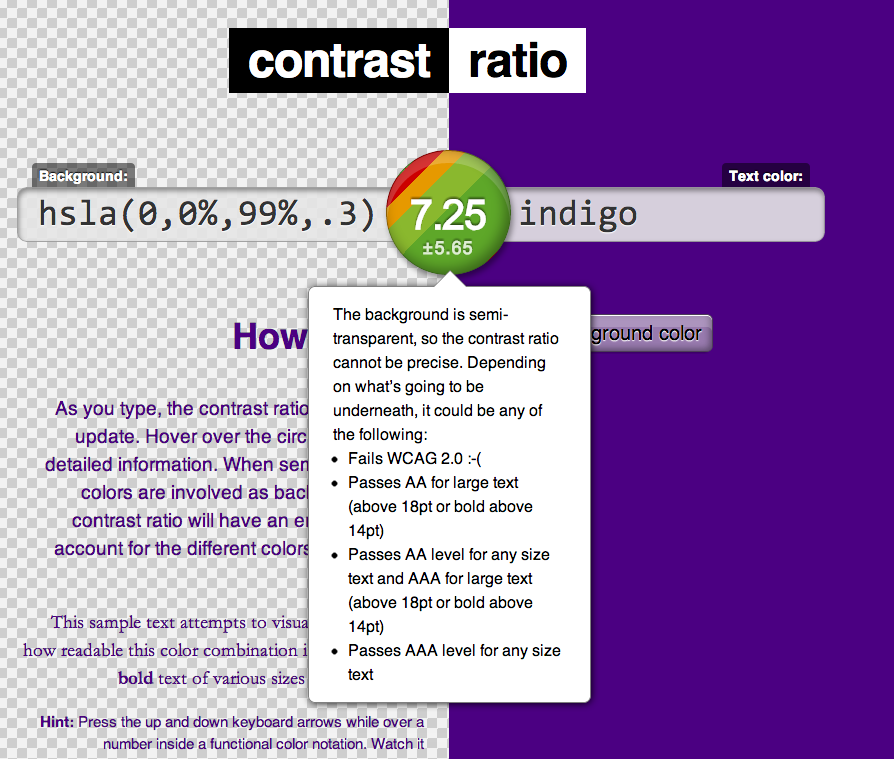 I was always interested in accessibility, but I never had to comply with any guidelines before. At W3C, accessibility is considered very important, so everything we make needs to pass WCAG 2.0 AA level. Therefore, I found myself calculating color contrast ratios very frequently. It was a very enlightening experience. I used to think that WCAG-mandated contrast ratios were too restrictive and basically tried to force you to use black and white, a sentiment shared by many designers I’ve spoken to. Surprisingly, in practice, I found that in most cases they are very reasonable: When a color combination doesn’t pass WCAG, it usually *is* hard to read. After all, the possible range for a contrast ratio is 1-21 but only ratios lower than 3 don’t pass WCAG AA (4.5 if you have smaller, non-bold text). So, effectively 90% of combinations will pass (82.5% for smaller, non-bold text).
There are plenty of tools out there for this. However, I found that my workflow for checking a contrast ratio with them was far from ideal. I had to convert my CSS colors to hex notation (which I don’t often use myself anymore), check the contrast ratio, then adjust the colors as necessary, covert again etc. In addition, I had to adjust the lightness of the colors with a blindfold, without being able to see the difference my adjustments would make to the contrast ratio. When using semi-transparent colors, it was even worse: Since WCAG only describes an algorithm for opaque colors, all contrast tools only expect that. So, I had to calculate the resulting opaque colors after alpha blending had taken place. After doing that for a few days, I got so fed up that I decided to make my own tool.
In addition, I discovered that there was no documented way of calculating the contrast ratio range that can be produced with a semi-transparent background, so I came up with an algorithm (after many successive failures to find the range intuitively), published it in the w3c-wai-ig mailing list and used the algorithm in my app, effectively making it the first one that can accept semi-transparent colors. If your math is less rusty than mine, I’d appreciate any feedback on my reasoning there.
Below is a list of features that make this tool unique for calculating color contrast ratios:
- Accepts any CSS color the browser does, not just hex colors. To do this, it defers parsing of the color to the browser, and queries the computed style, which is always rgb() or rgba() with 0-255 ranges which be parsed much more easily than the multitude of different formats than modern browsers accept (and the even more that are coming in the future).
- Updates as you type, when what you’ve typed can be parsed as a valid CSS color.
- Accepts semi transparent colors. For semi-transparent backgrounds, the contrast ratio is presented with an error margin, since it can vary depending on the backdrop. In that case, the result circle will not have a solid background, but a visualization of the different possible results and their likelihood (see screenshot).
- You can share your results by sharing the URL. The URL hashes have a reasonable structure of the form #foreground-on-background, e.g. #black-on-yellow so you can even adjust the URL as a form of input.
- You can adjust the color by incrementing or decrementing its components with the keyboard arrow keys until you get the contrast right. This is achieved by including my Incrementable library.
Browser support is IE10 and modern versions of Firefox, Safari, Chrome, Opera. Basic support for IE9. No responsive version yet, sorry (but you can always send pull requests!)
Save the link: contrast-ratio.com
Edit 2022: Link updated to reflect current one. Original link was leaverou.github.com/contrast-ratio
Dive deep into CSS3 (and Bolognese!) in Bologna, Italy
 I don’t usually like to advertise my talks or workshops through blog posts, and even though I’ve given a lot, I’ve only posted about less a handful. However, this one is special: It might be my last. Don’t get me wrong: I LOVE giving workshops, teaching people new things and seeing them put them in use right away is fantastic. However, I also find them incredibly exhausting. Speaking for an entire day (or sometimes two!) is pretty much the most tiring thing I’ve done. So, given my new job at W3C, I’m not sure if I will do one again. Of course, it goes without saying that I will still do plenty of talks! :)
The last workshop on my schedule is in FromTheFront conference in Bologna, Italy on September 20th (in 7 days!). There are still some spots available, so grab yours while you still can! It only costs €329.00. It will be very hands-on, with interactive exercises that help you gain first-hand experience with small but advanced use cases. It will not be your usual CSS3-overview kind of workshop. Instead, we will dive really deep into a handful of CSS3 aspects that I think are most useful for your everyday work.
While you’re at it, I’d also recommend getting a conference ticket as well. The line-up has some excellent speakers and it’s only €110 more, so totally worth it!
Apologies that my last two blog posts were personal, the next one will be more technical: I have a very useful tool in the pipeline that I’m gonna release soon ;)
Dive deep into CSS3 (and Bolognese!) in Bologna, Italy
I don’t usually like to advertise my talks or workshops through blog posts, and even though I’ve given a lot, I’ve only posted about less a handful. However, this one is special: It might be my last. Don’t get me wrong: I LOVE giving workshops, teaching people new things and seeing them put them in use right away is fantastic. However, I also find them incredibly exhausting. Speaking for an entire day (or sometimes two!) is pretty much the most tiring thing I’ve done. So, given my new job at W3C, I’m not sure if I will do one again. Of course, it goes without saying that I will still do plenty of talks! :)
The last workshop on my schedule is in FromTheFront conference in Bologna, Italy on September 20th (in 7 days!). There are still some spots available, so grab yours while you still can! It only costs €329.00. It will be very hands-on, with interactive exercises that help you gain first-hand experience with small but advanced use cases. It will not be your usual CSS3-overview kind of workshop. Instead, we will dive really deep into a handful of CSS3 aspects that I think are most useful for your everyday work.
While you’re at it, I’d also recommend getting a conference ticket as well. The line-up has some excellent speakers and it’s only €110 more, so totally worth it!
Apologies that my last two blog posts were personal, the next one will be more technical: I have a very useful tool in the pipeline that I’m gonna release soon ;)
lea@w3․org
 In my recent post describing how I got into web development I wrote that I’m in the verge of some big changes in my life. The main one of them starts tomorrow. As of tomorrow, the above will be my professional email. Yes, you guessed it right; I’m joining the W3C team! Yes, the same W3C you all know and love :) I decided to title this blog post with it, as I like how a 10 letter string manages to neatly summarize so much.
Working at W3C had been a dream of mine ever since I learned what a web standard is. As you probably know if you’ve been following my work, I’m a strong believer in open web standards. Even though proprietary technology might offer some short term benefits, in the long run only open standards can allow the Web to reach its full potential.
I’d like to especially thank the two people below (in chronological order). If it wasn’t for them, this dream would have never materialized:
- Oli Studholme: I still remember our IRC conversation back in January. I was telling him how much I’d love to work for W3C, but “I’m not that good”. He repeatedly encouraged me to contact W3C and express my interest, despite my strong reluctance to do so. “Don’t be like the 15 year old boy that is too shy to ask the girl out” was the argument that finally convinced me. He even asked around to find which person I should contact.
- Doug Schepers: If it wasn’t for Doug’s heroic efforts, this would have never happened. He believed in me from the start and did everything he could to for this to go through. He spent an incredible amount of time trying to help me, although I repeatedly bombarded him with a cornucopia of silly questions. :) Over the course of these 6 months, he didn’t just become a colleague, but also a friend.
Thank you both. I’m deeply grateful.
I will be part of the W3C developer relations and web education efforts, working a lot with Doug (aka @shepazu). In practice, this means:
- Help developers understand where standards are headed, and solicit early feedback on upcoming features.
- Help Working Groups understand what developers need.
- Help plan W3C developer events, including conferences
- Speaking about open web technologies at conferences and other events
- Writing articles and documentation about open web technologies
- Making demos and tools that demonstrate and help authors understand web standards
In addition, I will be helping with the design of many W3C-related things, as I will be the only designer at W3C.
As you can see I’ll be wearing many hats, which is exactly what I love about this role! I had many tempting offers from big US companies that offered salaries with more digits and a lot of perks. However, my heart wanted W3C and this role was practically tailored to my talents and interests.
I’m honored to be a part of W3C and I’m looking forward to helping out.
<voice type="fangirl">I have to admit I’m also really looking forward to meeting Sir Tim Berners-Lee in person! :D</voice>
lea@w3․org
In my recent post describing how I got into web development I wrote that I’m in the verge of some big changes in my life. The main one of them starts tomorrow. As of tomorrow, the above will be my professional email. Yes, you guessed it right; I’m joining the W3C team! Yes, the same W3C you all know and love :) I decided to title this blog post with it, as I like how a 10 letter string manages to neatly summarize so much.
Working at W3C had been a dream of mine ever since I learned what a web standard is. As you probably know if you’ve been following my work, I’m a strong believer in open web standards. Even though proprietary technology might offer some short term benefits, in the long run only open standards can allow the Web to reach its full potential.
I’d like to especially thank the two people below (in chronological order). If it wasn’t for them, this dream would have never materialized:
- Oli Studholme: I still remember our IRC conversation back in January. I was telling him how much I’d love to work for W3C, but “I’m not that good”. He repeatedly encouraged me to contact W3C and express my interest, despite my strong reluctance to do so. “Don’t be like the 15 year old boy that is too shy to ask the girl out” was the argument that finally convinced me. He even asked around to find which person I should contact.
- Doug Schepers: If it wasn’t for Doug’s heroic efforts, this would have never happened. He believed in me from the start and did everything he could to for this to go through. He spent an incredible amount of time trying to help me, although I repeatedly bombarded him with a cornucopia of silly questions. :) Over the course of these 6 months, he didn’t just become a colleague, but also a friend.
Thank you both. I’m deeply grateful.
I will be part of the W3C developer relations and web education efforts, working a lot with Doug (aka @shepazu). In practice, this means:
- Help developers understand where standards are headed, and solicit early feedback on upcoming features.
- Help Working Groups understand what developers need.
- Help plan W3C developer events, including conferences
- Speaking about open web technologies at conferences and other events
- Writing articles and documentation about open web technologies
- Making demos and tools that demonstrate and help authors understand web standards
In addition, I will be helping with the design of many W3C-related things, as I will be the only designer at W3C.
As you can see I’ll be wearing many hats, which is exactly what I love about this role! I had many tempting offers from big US companies that offered salaries with more digits and a lot of perks. However, my heart wanted W3C and this role was practically tailored to my talents and interests.
I’m honored to be a part of W3C and I’m looking forward to helping out.
<voice type="fangirl">I have to admit I’m also really looking forward to meeting Sir Tim Berners-Lee in person! :D</voice>