Reading List
The most recent articles from a list of feeds I subscribe to.
Leaving W3C
About a year ago, I announced I was joining W3C as a full-time staff member, to work on Developer Relations and education. Working at W3C was a dream come true and I can’t say I was disappointed. Over the past year I’ve worked with some amazingly brilliant people, hopefully increased awareness for web standards in the developer community and helped materialize the vision behind WebPlatform.org. It’s been a fun ride and working for a non-profit was very fulfilling. If somebody told me a year ago that I would decide to leave W3C on my own free will, I would’ve asked them what they were smoking. However, our future selves often surprise us and although it was the most difficult decision of my life, I recently decided to leave. July 31st will be my last day at W3C. I will attempt to describe the reasons below for anyone interested, but in no way does me leaving mean that I don’t deeply appreciate W3C or that I regretted joining. If I could go a year back, I would make the same choice.
Reason #1: I want to focus on other projects
I didn’t have much time to work on my pet projects, as my job was consuming pretty much the entire me. This is absolutely not W3C’s fault, it’s mine and a pretty common side effect of working from home. Pull requests kept piling up on Github, I didn’t have many ideas for new side projects or time for research & to come up with new techniques. I was able to work a bit on Dabblet and a WPD Prism plugin, as they were useful for WebPlatform.org, but for the most part, I wanted to work more on open source projects, do more research, blog more etc. I also recently signed a book deal with O’Reilly for a book on advanced CSS techniques (“CSS Secrets”, ETA Spring 2014) and I wanted to take some time off and write a great inaugural book, not just a decent one (and design it too!). I also kinda missed doing workshops or even client work, who knew!
Having more time will also mean I will be able to focus more on standards work, which is a huge passion of mine. I know it sounds odd to leave W3C to work more on …standards, but standards work was never a part of my job at W3C. If I wanted to devote time to actively participate in the CSS WG beyond the weekly telcon, or to the specification I edit, I would have to do it outside work hours. Obviously, I will still have to do it in my free time, but I recall having more of that when I was self-employed.
Reason #2: I want to grow
I want to be in a job that’s a challenge, that helps me grow and become a better professional. While I appreciate WebPlatform.org, I didn’t feel that doing front-end development & design on it made me particularly better at what I do, at least compared to other things I could have been doing in the past year. It could be a perfect opportunity to grow for someone else, but it wasn’t for me.
I did become a better public speaker over the past year, but I would likely be doing as many talks anyway. I got some valuable conference organizing experience from W3Conf, which I thoroughly enjoyed working on, but that was only a small part of my work.
Reason #3: Different direction
Had I stayed, my job description for the upcoming year would have a slightly different focus. Since W3C Developer Relations was a new activity, neither Doug (my manager) nor I were quite sure how we could make the biggest impact, so we were experimenting to some degree. A few months after I joined, WebPlatform.org launched and we slowly concentrated our efforts on that. If I had stayed for another year, my job would have an even stronger WebPlatform.org focus. Half of it would be front-end design & development and even writing documentation for a day per week. That meant I would have to cut down many parts of my job that I enjoyed and wanted to concentrate more on, such as public speaking and event planning, and though it includes some public-facing activities like gathering feedback from developers, I’d like to do even more of that. This was not a bad decision on W3C’s part — WebPlatform.org needs somebody concentrating on those aspects of it. However, although I strongly believe in the vision behind the project, this was not what I would personally enjoy doing.
Thank you, W3C
Even though I’m leaving W3C, it will always have a very special place in my heart. I met & worked with the most brilliant people I have ever met. Special mention to Amy, who did not just prove to be an intelligent, interesting and kind person, but also a great friend in the past couple of weeks that I got to know her better. I got to visit MIT and work from there for a while, which was an incredible experience. I got to contribute to WebPlatform.org which is a very ambitious and honorable project that I strongly believe in. I got to co-organize W3Conf, which turned out to a successful and fun conference.
Me leaving is a personal decision that has less to do with W3C and more to do with what I want out of life. But I’m going to sorely miss the W3C Team, the culture, the technical discussions. It’s been a fun ride and I’m grateful for the chance and the trust W3C placed in me. In fact, I wouldn’t be surprised to find myself working for W3C again at some point in the future, in some way or in a different role.
But for now, here’s to the future! I’m thrilled.
Want to work at W3C?
As you can imagine, there is one more opening now. :) Are you a great designer with front-end development skills? Are you passionate about creating the best open web platform documentation on the Web? Apply now! You will be able to work from wherever in the world you want, whatever hours in the day you want, you will have great autonomy and a pretty cool boss. Sweet, huh?
Leaving W3C
About a year ago, I announced I was joining W3C as a full-time staff member, to work on Developer Relations and education. Working at W3C was a dream come true and I can’t say I was disappointed. Over the past year I’ve worked with some amazingly brilliant people, hopefully increased awareness for web standards in the developer community and helped materialize the vision behind WebPlatform.org. It’s been a fun ride and working for a non-profit was very fulfilling. If somebody told me a year ago that I would decide to leave W3C on my own free will, I would’ve asked them what they were smoking. However, our future selves often surprise us and although it was the most difficult decision of my life, I recently decided to leave. July 31st will be my last day at W3C. I will attempt to describe the reasons below for anyone interested, but in no way does me leaving mean that I don’t deeply appreciate W3C or that I regretted joining. If I could go a year back, I would make the same choice.
Reason #1: I want to focus on other projects
I didn’t have much time to work on my pet projects, as my job was consuming pretty much the entire me. This is absolutely not W3C’s fault, it’s mine and a pretty common side effect of working from home. Pull requests kept piling up on Github, I didn’t have many ideas for new side projects or time for research & to come up with new techniques. I was able to work a bit on Dabblet and a WPD Prism plugin, as they were useful for WebPlatform.org, but for the most part, I wanted to work more on open source projects, do more research, blog more etc. I also recently signed a book deal with O’Reilly for a book on advanced CSS techniques (“CSS Secrets”, ETA Spring 2014) and I wanted to take some time off and write a great inaugural book, not just a decent one (and design it too!). I also kinda missed doing workshops or even client work, who knew!
Having more time will also mean I will be able to focus more on standards work, which is a huge passion of mine. I know it sounds odd to leave W3C to work more on …standards, but standards work was never a part of my job at W3C. If I wanted to devote time to actively participate in the CSS WG beyond the weekly telcon, or to the specification I edit, I would have to do it outside work hours. Obviously, I will still have to do it in my free time, but I recall having more of that when I was self-employed.
Reason #2: I want to grow
I want to be in a job that’s a challenge, that helps me grow and become a better professional. While I appreciate WebPlatform.org, I didn’t feel that doing front-end development & design on it made me particularly better at what I do, at least compared to other things I could have been doing in the past year. It could be a perfect opportunity to grow for someone else, but it wasn’t for me.
I did become a better public speaker over the past year, but I would likely be doing as many talks anyway. I got some valuable conference organizing experience from W3Conf, which I thoroughly enjoyed working on, but that was only a small part of my work.
Reason #3: Different direction
Had I stayed, my job description for the upcoming year would have a slightly different focus. Since W3C Developer Relations was a new activity, neither Doug (my manager) nor I were quite sure how we could make the biggest impact, so we were experimenting to some degree. A few months after I joined, WebPlatform.org launched and we slowly concentrated our efforts on that. If I had stayed for another year, my job would have an even stronger WebPlatform.org focus. Half of it would be front-end design & development and even writing documentation for a day per week. That meant I would have to cut down many parts of my job that I enjoyed and wanted to concentrate more on, such as public speaking and event planning, and though it includes some public-facing activities like gathering feedback from developers, I’d like to do even more of that. This was not a bad decision on W3C’s part — WebPlatform.org needs somebody concentrating on those aspects of it. However, although I strongly believe in the vision behind the project, this was not what I would personally enjoy doing.
Thank you, W3C
Even though I’m leaving W3C, it will always have a very special place in my heart. I met & worked with the most brilliant people I have ever met. Special mention to Amy, who did not just prove to be an intelligent, interesting and kind person, but also a great friend in the past couple of weeks that I got to know her better. I got to visit MIT and work from there for a while, which was an incredible experience. I got to contribute to WebPlatform.org which is a very ambitious and honorable project that I strongly believe in. I got to co-organize W3Conf, which turned out to a successful and fun conference.
Me leaving is a personal decision that has less to do with W3C and more to do with what I want out of life. But I’m going to sorely miss the W3C Team, the culture, the technical discussions. It’s been a fun ride and I’m grateful for the chance and the trust W3C placed in me. In fact, I wouldn’t be surprised to find myself working for W3C again at some point in the future, in some way or in a different role.
But for now, here’s to the future! I’m thrilled.
Want to work at W3C?
As you can imagine, there is one more opening now. :) Are you a great designer with front-end development skills? Are you passionate about creating the best open web platform documentation on the Web? Apply now! You will be able to work from wherever in the world you want, whatever hours in the day you want, you will have great autonomy and a pretty cool boss. Sweet, huh?
Meet dpi.lv: More than you probably wanted to know about screen DPI
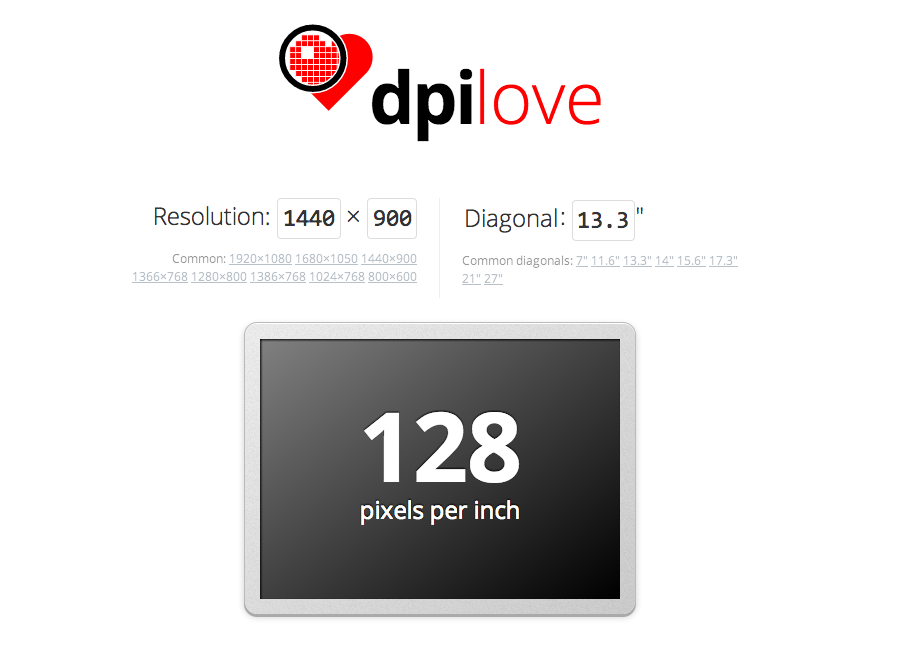
Yesterday (Sunday) I was on a 9.5 hour flight from Canada with no inflight entertainment (well, thanks Air Canada), so I did what every bored human being would do instead of watching movies: I decided to code an app! And out of the infinite set of possible apps somebody can make, I decided to make an app to calculate screen DPI/PPI.
You might be wondering if I’m still (?) sane, but you might be surprised to hear I found myself calculating screen PPIs quite frequently and wanted to save myself the hassle of doing the math every time. I’m a curious person and I wanted to know, even about products I would never buy and even when it wasn’t listed in the tech specs. Yes, my hobbies are somewhat weird. :o
I first thought about doing such an app a while ago, but never found the time to code it. The last time I had thought about it was a few days ago at the SF Apple Store with a friend. We were looking at the 27" Apple Thunderbolt displays in awe and thought they must have huge pixel density. After a few calculations in the console (which ironically produced a result faster than the Apple guy my friend asked), it turned out it was only …102. “I need to code an app to make this sort of calculation easy! People are being misled by marketing!” I thought.
Fast forward to my flight. You didn’t expect my laptop battery to last for 9.5 hours, right? Yeah, MacBook Air batteries are good, but not *that* good. Of course it eventually died so I had to find other ways to pass my time (I ended up sleeping — or trying to). However, by the time it died, I had gone over the threshold of being able to give it up, so I spent the rest of the day finishing it, despite my obvious jetlag and sleepiness. I was in the zone — You don’t just go sleeping when you’re in the zone, right?
Besides the DPI/PPI calculator, I added a few other fun things too:
- A list of devices with pre-calculated data (stored in a separate JSON file, which makes it easy to update — *hint, hint*)
- Wrote a few FAQ items about DPI/PPI.
- Like many of my apps, it supports link sharing through URL hashes (for examples, check the screens section).
- I even bought a proper domain for it (dpi.lv) and drew a logo! The logo took hours by itself. Not just to draw it, but to simplify Illustrator’s ugly, repetitive SVG output (which is still better than what most other tools spit out). Hand-simplifying SVG is a meditative experience that I thoroughly enjoy, to the bewilderment of everyone who read my tweet about it. Just for the lulz, here’s the before and the 66% smaller after (the small design tweaks were intentional)
- The screen that displays the result resizes to reflect the aspect ratio of the resolution you’ve selected. It even animates to it, with CSS transitions! Oh, and it also uses FlexBox to center the text vertically.


Of course it’s open source (under an MIT license, as usual), and you can fork it on Github, as usual. The JS is a bit of a mess, but I’m too tired to refactor it now. Same goes for the lack of favicon and tagline. Oh well. I still like it. :)
Important: If you are on a display with multiple dots per pixel (e.g. Retina), the resolution (pixel width × pixel height) it tries to guess will be incorrect, so you’ll have to actually input the right one. The default resolution in there is just a hint, it doesn’t mean it’s “broken” if it doesn’t guess right, they’re editable fields. That said, it would be nice to guess right in those cases too, and I will look into it.
Meet dpi.lv: More than you probably wanted to know about screen DPI
Yesterday (Sunday) I was on a 9.5 hour flight from Canada with no inflight entertainment (well, thanks Air Canada), so I did what every bored human being would do instead of watching movies: I decided to code an app! And out of the infinite set of possible apps somebody can make, I decided to make an app to calculate screen DPI/PPI.
You might be wondering if I’m still (?) sane, but you might be surprised to hear I found myself calculating screen PPIs quite frequently and wanted to save myself the hassle of doing the math every time. I’m a curious person and I wanted to know, even about products I would never buy and even when it wasn’t listed in the tech specs. Yes, my hobbies are somewhat weird. :o
I first thought about doing such an app a while ago, but never found the time to code it. The last time I had thought about it was a few days ago at the SF Apple Store with a friend. We were looking at the 27" Apple Thunderbolt displays in awe and thought they must have huge pixel density. After a few calculations in the console (which ironically produced a result faster than the Apple guy my friend asked), it turned out it was only …102. “I need to code an app to make this sort of calculation easy! People are being misled by marketing!” I thought.
Fast forward to my flight. You didn’t expect my laptop battery to last for 9.5 hours, right? Yeah, MacBook Air batteries are good, but not *that* good. Of course it eventually died so I had to find other ways to pass my time (I ended up sleeping — or trying to). However, by the time it died, I had gone over the threshold of being able to give it up, so I spent the rest of the day finishing it, despite my obvious jetlag and sleepiness. I was in the zone — You don’t just go sleeping when you’re in the zone, right?
Besides the DPI/PPI calculator, I added a few other fun things too:
- A list of devices with pre-calculated data (stored in a separate JSON file, which makes it easy to update — *hint, hint*)
- Wrote a few FAQ items about DPI/PPI.
- Like many of my apps, it supports link sharing through URL hashes (for examples, check the screens section).
- I even bought a proper domain for it (dpi.lv) and drew a logo! The logo took hours by itself. Not just to draw it, but to simplify Illustrator’s ugly, repetitive SVG output (which is still better than what most other tools spit out). Hand-simplifying SVG is a meditative experience that I thoroughly enjoy, to the bewilderment of everyone who read my tweet about it. Just for the lulz, here’s the before and the 66% smaller after (the small design tweaks were intentional)
- The screen that displays the result resizes to reflect the aspect ratio of the resolution you’ve selected. It even animates to it, with CSS transitions! Oh, and it also uses FlexBox to center the text vertically.
Of course it’s open source (under an MIT license, as usual), and you can fork it on Github, as usual. The JS is a bit of a mess, but I’m too tired to refactor it now. Same goes for the lack of favicon and tagline. Oh well. I still like it. :)
Important: If you are on a display with multiple dots per pixel (e.g. Retina), the resolution (pixel width × pixel height) it tries to guess will be incorrect, so you’ll have to actually input the right one. The default resolution in there is just a hint, it doesn’t mean it’s “broken” if it doesn’t guess right, they’re editable fields. That said, it would be nice to guess right in those cases too, and I will look into it.
Can we get rid of gradient prefixes?
I recently realized that unprefixed gradients finally propagated to stable Chrome, and after tweeting about it, I decided to do some research on which browsers support unprefixed gradients, and what percentage of users needs them.
Currently, unprefixed gradients are supported in:
- Chrome 26+
- Firefox 16+
- Opera 12.10+
- IE10+
Lets have a look at which prefixes we actually need to use for gradients today.
-ms-
There was never a stable release of IE that supported -ms- prefixed gradients, those were only in preview versions (stable IE10 supports both prefixed and unprefixed gradients). So, -ms- is most definitely not required.
-moz-
Firefox versions >= 3.6 and < 16 account for 4% of the global user base*. This might or might not be significant, depending on how good the fallback is that these users will see. If the gradient only adds a subtle shadow or something like that, I’d say ditch -moz-. If it’s more crucial to the design & branding, it might be wise to still keep it. More tech-focused websites probably have a much lower percentage than 4%, so it might be a good idea to drop it there completely.
-o-
Opera unprefixed gradients in 12.10. Opera Mini never supported them. Opera versions < 12.10 currently account to a total of 0.25% of the global user base*. I’d say it’s safe to ditch -o- in gradients in most cases.
-webkit-
Chrome only very recently unprefixed gradients and Safari is a long way from doing so. Not to mention all the mobile browsers using WebKit. Unfortunately, we can’t ditch -webkit- in CSS gradients just yet.
My opinion
Don’t use -ms- prefixed gradients, there’s absolutely zero point in doing so. Include -moz- for the less subtle gradients. No significant need for -o- gradients. -webkit- is still needed and probably will be at least until the end of 2013. Or, of course, just use -prefix-free and don’t bother. :P
Keep in mind that your stats might differ from global stats, so which prefixes you need to include might differ on a case by case basis. The purpose of this post is to alert you that maybe you don’t need all these prefixes, not to prescriptively tell you which ones to keep. Except -ms-, please don’t use that. There’s absolutely zero reason whatsoever.
Last but not least, no matter which prefixes you include, always have a good solid color fallback!
* Global market share statistics from StatCounter, for a 3 month period of January 2013 - March 2013. The graph on the website only displays the most popular browser versions, but downloading the CSV file gives you all of them.