Reading List
The most recent articles from a list of feeds I subscribe to.
My positive experience as a woman in tech
Women speaking up about the sexism they have experienced in tech is great for raising awareness about the issues. However, when no positive stories get out, the overall picture painted is bleak, which could scare even more women away.
Lucky for me, I fell in love with programming a decade before I even heard there is a sexism problem in tech. Had I read about it before, I might have decided to go for some other profession. Who wants to be fighting an uphill battle all her life?
Thankfully, my experience has been quite different. Being in this industry has brought me nothing but happiness. Yes, there are several women who have had terrible experiences, and I’m in no way discounting them. They may even be the majority, though I am not aware of any statistics. However, there is also the other side. Those of us who have had incredibly positive experiences, and have always been treated with nothing but respect. That side’s stories need to be heard too, not silenced out of fear that we will become complacent and stop trying for more equality. Stories like mine should become the norm, not the exception.
I’ve had a number of different roles in tech over the course of my life. I’ve been a student, a speaker & author, I’ve worked at W3C, I’ve started & maintain several successful open source projects and I’m currently dabbling in Computer Science research. In none of these roles did I ever feel I was unfairly treated due to my gender. That is not because I’m oblivious to sexism. I tend to be very sensitive to seeing it, and I often notice even the smallest acts of sexism (“death by a thousand paper cuts”). I see a lot of sexism in society overall. However, inside this industry, my gender never seemed to matter much, except perhaps in positive ways.
On my open source repos, I have several contributors, the overwhelming majority of which, is male. I’ve never felt less respected due to my gender. I’ve never felt that my work was taken less seriously than male OSS developers. I’ve never felt my contributors would not listen to me. I’ve never felt my work was unfairly scrutinized. Even when I didn’t know something, or introduced a horrible bug, I’ve never been insulted or berated. The community has been nothing but friendly, helpful and respectful. If anything, I’ve sometimes wondered if my gender is the reason I hardly ever get any shit!
On stage, I’ve never gotten any negative reactions. My talks always get excellent reviews, which have nothing to do with me being female. There is sometimes the odd complimentary tweet about my looks, but that’s not only exceedingly rare, but also always combined with a compliment about the actual talk content. My gender only affected my internal motivation: I often felt I had to be good, otherwise I would be painting all female tech speakers in a negative light. But other people are not at fault for my own stereotype threat.
My book, CSS Secrets, has been as successful as an advanced CSS book could possibly aspire to be and got to an average of 5 stars on Amazon only a few months after its release. It’s steadily the 5th bestseller on CSS and was No 1 for a while shortly after publication. My gender did not seem to negatively affect any of that, even though there’s a picture of me in the french flap so there are no doubts about me being female (as if the name Lea wasn’t enough of a hint).
As a student, I’ve never felt unfairly treated due to my gender by any of my professors, even the ones in Greece, a country that is not particularly famous for its gender equal society, to put it mildly.
As a new researcher, I have no experience with publishing papers yet, so I cannot share any experiences on that. However, I’ve been treated with nothing but respect by both my advisor and colleagues. My opinion is always heard and valued and even when people don’t agree, I can debate it as long and as intensely as I want, without being seen as aggressive or “bossy”.
I’ve worked at W3C and still participate as an Invited Expert in the CSS Working Group. In neither of these roles did my gender seem to matter in any way. I’ve always felt that my expertise and skillset were valued and my opinions heard. In fact, the most well-respected member of the CSS WG, is the only other woman in it: fantasai.
Lastly, In all my years as a working professional, I’ve always negotiated any kind of remuneration, often hard. I’ve never lost an opportunity because of it, or been treated with negativity afterwards.
On the flip side, sexism today is rarely overt. Given that hardly anybody over ten will flat out admit they think women are inferior (even to themselves), it’s often hard to tell when a certain behavior stems from sexist beliefs. If someone is a douchebag to you, are they doing it because you’re a woman, or because they’re douchebags? If someone is criticizing your work, are they doing it because they genuinely found something to criticize or because they’re negatively predisposed due to your gender? It’s impossible to know, especially since they don’t know either! If you confront them on their sexism, they will deny all of it, and truly believe it. It takes a lot of introspection to see one’s internalized stereotypes. Therefore, a lot of the time, you cannot be sure if you have experienced sexist behavior, and there is no way to find out for sure, since the perpetrator doesn’t know either. There are many false positives and false negatives there.
Perhaps I don’t feel I have experienced much sexism because I prefer to err on the side of false negatives. Paraphrasing Blackstone, I would rather not call out sexist behavior ten times, than wrongly accuse someone of it once. It might also have to do with my personality: I’m generally confident and can be very assertive. When somebody is being a jerk to me, I will not curl in a ball and question my life choices, I will reply to them in the same tone. However, those two alone cannot make the difference between a pit rampant with sexism and an egalitarian paradise. I think a lot of it is that we have genuinely made progress, and we should celebrate it with more women coming out with their positive experiences (it cannot just be me, right?).
Ironically, one of the very few times I have experienced any sexism in the industry was when a dude was trying to be nice to me. I was in a speaker room at a conference in Las Vegas, frantically working on my slides, not participating in any of the conversations around me. At some point, one of the guys said “fuck” in a conversation, then turned and apologized to me. Irritated about the sudden interruption, I lifted my head and looked around. I noticed for the first time that day that I was the only woman in the room. His effort to be courteous made me feel that I was different, the odd one out, the one we must be careful around and treat like a fragile flower. To this day, I regret being too startled to reply “Eh, I don’t give a fuck”.
Introducing Bliss: A 3KB library for happier Vanilla JS
 Anyone who follows this blog, my twitter, or my work probably is aware that I’m not a huge fan of big libraries. I think wrapper objects are messy, and big libraries are overkill for smaller projects. On large projects, one uses frameworks like React or Angular anyway, not libraries.
Anyone who writes Vanilla JS on a daily basis probably is aware that it can sometimes be, ahem, somewhat unpleasant to work with. Sure, the situation is orders of magnitude better than it was when I started. Back then, IE6 was the dominant browser and you needed a helper function to even add event listeners to an element (remember element.attachEvent?) or to get elements by a class!
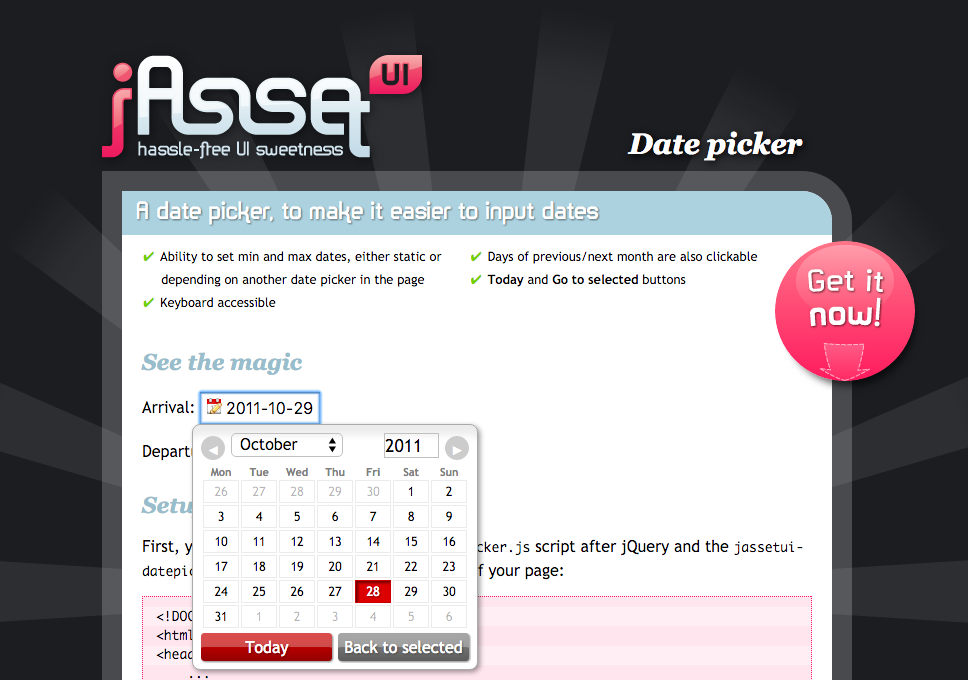
Fun fact: I learned JavaScript back then by writing my own library, called jAsset. I had not heard of jQuery when I started it in 2007, so I had even coded my own selector engine! (Anyone remember slickspeed?) jAssset had plenty of nice helper functions, its own UI library and a cool logo. I had even started to make a website for its UI components, seen on the right.
 Sadly, jAsset died the sad inevitable death of all unreleased projects: Without external feedback, I had nobody to hold me back from adding to its API every time I personally needed a helper function. And adding, and adding, and adding… Until it became 5000+ loc long and its benefit of being lightweight or comprehensible had completely vanished. It collapsed under its own weight before it even saw the light of day. I abandoned it and went through a few years of using jQuery as my preferred helper library. Eventually, my distaste for wrapper objects, the constantly improving browser support for new APIs that made Vanilla JS more palatable, and the decline of overly conspicuous browser bugs led me to give it up.
It was refreshing, and educational, but soon I came to realize that while Vanilla JS is orders of magnitude better than it was when I started, certain APIs are still quite unwieldy, which can be annoying if you use them often. For example, the Vanilla JS for creating an element, with other elements inside it, events and inline styles is so commonly needed, but also so verbose and WET, it can make one suicidal.
However, Vanilla JS does not mean “use no abstractions”. Programming is all about abstractions! The Vanilla JS movement, is about favoring speed, smaller abstractions and understanding of the Web Platform, over big libraries that we treat as a black box. It’s about using libraries to save time, not to skip learning.
So, I used my own tiny helpers, on every project. They were small and easy to understand, instead of several KB of code aiming to fix browser bugs I will likely never encounter and let me create complex nested DOM structures with a single JSON-like object. Over time, their API solidified and improved. On larger projects it was a separate file which I had tentatively codenamed Utopia (due to the lack of browser bug fixes and optimistic use of modern APIs). On smaller ones just a few helper methods (I could not live without at least my tiny 2 sloc $() and $$() helpers!). Here is a sample from my open source repos:
- dabblet.com/utopia.js
- regexplained/utopia.js
- dpi.lv/utopia.js
- css3test.com/utopia.js
- awesomplete.js
- $() and/or $$() helpers in:
Notice any recurring themes there? :)
I never mentioned Utopia.js anywhere, besides silently including it in my projects, so it went largely unnoticed. Sometimes people would look at it, ask me to release it, I’d promise them I would and then nothing. A few years ago, someone noticed it, liked it and documented it a bit (site is down now it seems). However, it was largely my little secret, hidden in public view.
For the past half year, I’ve been working hard on my research project at MIT. It’s pretty awesome and is aimed at helping people who know HTML/ CSS but not JS, achieve more with Web technologies (and that’s all I can say for now). It’s also written in JS, so I used Utopia as a helper library, naturally. Utopia evolved even more with this project, got renamed to Bliss and got chainability via my idea about extending DOM prototypes without collisions (can be disabled and the property name is customizable).
All this worked fine while I was the only person working on the project. Thankfully, I might get some help soon, and it might be rather inexperienced (the academia equivalent of interns). Help is very welcome, but it did raise the question: How will these people, who likely only know jQuery, work on the project? [1]
The answer was that the time has come to polish, document and release Bliss to the world. My plan was to spend a weekend documenting it, but it ended up being a little over a week on and off, when procrastinating from other tasks I had to do. However, I’m very proud of the resulting docs, so much that I gifted myself a domain for it. They are fairly extensive (though some functions still need work) and has two things I always missed in other API docs:
- Recommendations about what Vanilla JS to use instead when appropriate, instead of guiding people into using library methods even when Vanilla JS would have been perfectly sufficient.
- A “Show Implementation” button showing the implementation, so you can both learn, and judge whether it’s needed or not, instead of assuming that you should use it over Vanilla JS because it has magic pixie dust. This way, the docs also serve as a source viewer!
So, enjoy Bliss. The helper library for people who don’t like helper libraries. :) In a way, it feels that a journey of 8 years, finally ends today. I hope the result makes you blissful too.
Oh, and don’t forget to follow @blissfuljs on twitter!
[1]: Academia is often a little behind tech-wise, so everyone uses jQuery here — hardly any exceptions. Even though browser support doesn’t usually even matter to research projects!
Introducing Bliss: A 3KB library for happier Vanilla JS
Anyone who follows this blog, my twitter, or my work probably is aware that I’m not a huge fan of big libraries. I think wrapper objects are messy, and big libraries are overkill for smaller projects. On large projects, one uses frameworks like React or Angular anyway, not libraries.
Anyone who writes Vanilla JS on a daily basis probably is aware that it can sometimes be, ahem, somewhat unpleasant to work with. Sure, the situation is orders of magnitude better than it was when I started. Back then, IE6 was the dominant browser and you needed a helper function to even add event listeners to an element (remember element.attachEvent?) or to get elements by a class!
Fun fact: I learned JavaScript back then by writing my own library, called jAsset. I had not heard of jQuery when I started it in 2007, so I had even coded my own selector engine! (Anyone remember slickspeed?) jAssset had plenty of nice helper functions, its own UI library and a cool logo. I had even started to make a website for its UI components, seen on the right.
Sadly, jAsset died the sad inevitable death of all unreleased projects: Without external feedback, I had nobody to hold me back from adding to its API every time I personally needed a helper function. And adding, and adding, and adding… Until it became 5000+ loc long and its benefit of being lightweight or comprehensible had completely vanished. It collapsed under its own weight before it even saw the light of day. I abandoned it and went through a few years of using jQuery as my preferred helper library. Eventually, my distaste for wrapper objects, the constantly improving browser support for new APIs that made Vanilla JS more palatable, and the decline of overly conspicuous browser bugs led me to give it up.
It was refreshing, and educational, but soon I came to realize that while Vanilla JS is orders of magnitude better than it was when I started, certain APIs are still quite unwieldy, which can be annoying if you use them often. For example, the Vanilla JS for creating an element, with other elements inside it, events and inline styles is so commonly needed, but also so verbose and WET, it can make one suicidal.
However, Vanilla JS does not mean “use no abstractions”. Programming is all about abstractions! The Vanilla JS movement, is about favoring speed, smaller abstractions and understanding of the Web Platform, over big libraries that we treat as a black box. It’s about using libraries to save time, not to skip learning.
So, I used my own tiny helpers, on every project. They were small and easy to understand, instead of several KB of code aiming to fix browser bugs I will likely never encounter and let me create complex nested DOM structures with a single JSON-like object. Over time, their API solidified and improved. On larger projects it was a separate file which I had tentatively codenamed Utopia (due to the lack of browser bug fixes and optimistic use of modern APIs). On smaller ones just a few helper methods (I could not live without at least my tiny 2 sloc $() and $$() helpers!). Here is a sample from my open source repos:
- dabblet.com/utopia.js
- regexplained/utopia.js
- dpi.lv/utopia.js
- css3test.com/utopia.js
- awesomplete.js
- $() and/or $$() helpers in:
Notice any recurring themes there? :)
I never mentioned Utopia.js anywhere, besides silently including it in my projects, so it went largely unnoticed. Sometimes people would look at it, ask me to release it, I’d promise them I would and then nothing. A few years ago, someone noticed it, liked it and documented it a bit (site is down now it seems). However, it was largely my little secret, hidden in public view.
For the past half year, I’ve been working hard on my research project at MIT. It’s pretty awesome and is aimed at helping people who know HTML/ CSS but not JS, achieve more with Web technologies (and that’s all I can say for now). It’s also written in JS, so I used Utopia as a helper library, naturally. Utopia evolved even more with this project, got renamed to Bliss and got chainability via my idea about extending DOM prototypes without collisions (can be disabled and the property name is customizable).
All this worked fine while I was the only person working on the project. Thankfully, I might get some help soon, and it might be rather inexperienced (the academia equivalent of interns). Help is very welcome, but it did raise the question: How will these people, who likely only know jQuery, work on the project? [1]
The answer was that the time has come to polish, document and release Bliss to the world. My plan was to spend a weekend documenting it, but it ended up being a little over a week on and off, when procrastinating from other tasks I had to do. However, I’m very proud of the resulting docs, so much that I gifted myself a domain for it. They are fairly extensive (though some functions still need work) and has two things I always missed in other API docs:
- Recommendations about what Vanilla JS to use instead when appropriate, instead of guiding people into using library methods even when Vanilla JS would have been perfectly sufficient.
- A “Show Implementation” button showing the implementation, so you can both learn, and judge whether it’s needed or not, instead of assuming that you should use it over Vanilla JS because it has magic pixie dust. This way, the docs also serve as a source viewer!
So, enjoy Bliss. The helper library for people who don’t like helper libraries. :) In a way, it feels that a journey of 8 years, finally ends today. I hope the result makes you blissful too.
Oh, and don’t forget to follow @blissfuljs on twitter!
[1]: Academia is often a little behind tech-wise, so everyone uses jQuery here — hardly any exceptions. Even though browser support doesn’t usually even matter to research projects!
Copying object properties, the robust way
If, like me, you try to avoid using heavy libraries when not needed, you must have definitely written a helper to copy properties from one object to another at some point. It’s needed so often that it’s just silly to write the same loops over and over again.
These days, most of my time is spent working on my research project at MIT, which I will hopefully reveal later this year. In that, I’m using a lightweight homegrown helper library, which I might release separately at some point as I think it has potential in its own right, for a number of reasons.
Of course, it needed to have a simple extend() method as well, to copy properties from one object to another. Let’s assume for the purposes of this article that we’re talking about shallow copying, that overwrites are allowed, and let’s omit hasOwnProperty() checks to make code easier to read.
It’s a simple task, right? Our first attempt might look like this:
$.extend = function (to, from) {
	for (var property in from) {
		to[property] = from[property];
	}

	return to;
}
This works fine, until you try it on objects with accessors or other types of properties defined via Object.defineProperty() or get/set keywords. What do you do then? Our next iteration could look like this:
$.extend = function (to, from) {
	for (var property in from) {
		Object.defineProperty(to, property, Object.getOwnPropertyDescriptor(from, property));
	}

	return to;
}
This works much better, until it fails, and it can fail pretty epically. Try this:
$.extend(document.body.style, {
	backgroundColor: "red"
});
Both in Chrome and Firefox, the results are super weird. Even though reading document.body.style.backgroundColor will return "red", no style will have actually been applied. In Firefox it even destroyed the native setter entirely and any future attempts to set document.body.style.backgroundColor in the console did absolutely nothing.
In contrast, the previous naïve approach worked fine for this. It’s clear that we need to somehow combine the two approaches, using Object.defineProperty() only when actually needed. But when is it actually not needed?
One obvious case is if the descriptor is undefined (such as with some native properties). Also, in simple properties, such as those in our object literal, the descriptor will be of the form {value: somevalue, writable: true, enumerable: true, configurable: true}. So, the next obvious step would be:
$.extend = function (to, from) {
	var descriptor = Object.getOwnPropertyDescriptor(from, property);

	if (descriptor && (!descriptor.writable || !descriptor.configurable || !descriptor.enumerable || descriptor.get || descriptor.set)) {
		Object.defineProperty(to, property, descriptor);
	}
	else {
		to[property] = from[property];
	}
}
This works perfectly, but is a little clumsy. I’ve currently left it at that, but any suggestions for making it more elegant are welcome :)
FWIW, I looked at jQuery’s implementation of jQuery.extend() after this, and it seems it doesn’t even handle accessors at all, unless I missed something. Time for a pull request, perhaps…
Edit: As MaxArt pointed out in the comments, there is a similar native method in ES6, Object.assign(). However, it does not deal with copying accessors, so does not deal with this problem either.
Copying object properties, the robust way
If, like me, you try to avoid using heavy libraries when not needed, you must have definitely written a helper to copy properties from one object to another at some point. It’s needed so often that it’s just silly to write the same loops over and over again.
These days, most of my time is spent working on my research project at MIT, which I will hopefully reveal later this year. In that, I’m using a lightweight homegrown helper library, which I might release separately at some point as I think it has potential in its own right, for a number of reasons.
Of course, it needed to have a simple extend() method as well, to copy properties from one object to another. Let’s assume for the purposes of this article that we’re talking about shallow copying, that overwrites are allowed, and let’s omit hasOwnProperty() checks to make code easier to read.
It’s a simple task, right? Our first attempt might look like this:
$.extend = function (to, from) {
	for (var property in from) {
		to[property] = from[property];
	}

	return to;
}
This works fine, until you try it on objects with accessors or other types of properties defined via Object.defineProperty() or get/set keywords. What do you do then? Our next iteration could look like this:
$.extend = function (to, from) {
	for (var property in from) {
		Object.defineProperty(to, property, Object.getOwnPropertyDescriptor(from, property));
	}

	return to;
}
This works much better, until it fails, and it can fail pretty epically. Try this:
$.extend(document.body.style, {
	backgroundColor: "red"
});
Both in Chrome and Firefox, the results are super weird. Even though reading document.body.style.backgroundColor will return "red", no style will have actually been applied. In Firefox it even destroyed the native setter entirely and any future attempts to set document.body.style.backgroundColor in the console did absolutely nothing.
In contrast, the previous naïve approach worked fine for this. It’s clear that we need to somehow combine the two approaches, using Object.defineProperty() only when actually needed. But when is it actually not needed?
One obvious case is if the descriptor is undefined (such as with some native properties). Also, in simple properties, such as those in our object literal, the descriptor will be of the form {value: somevalue, writable: true, enumerable: true, configurable: true}. So, the next obvious step would be:
$.extend = function (to, from) {
	var descriptor = Object.getOwnPropertyDescriptor(from, property);

	if (descriptor && (!descriptor.writable || !descriptor.configurable || !descriptor.enumerable || descriptor.get || descriptor.set)) {
		Object.defineProperty(to, property, descriptor);
	}
	else {
		to[property] = from[property];
	}
}
This works perfectly, but is a little clumsy. I’ve currently left it at that, but any suggestions for making it more elegant are welcome :)
FWIW, I looked at jQuery’s implementation of jQuery.extend() after this, and it seems it doesn’t even handle accessors at all, unless I missed something. Time for a pull request, perhaps…
Edit: As MaxArt pointed out in the comments, there is a similar native method in ES6, Object.assign(). However, it does not deal with copying accessors, so does not deal with this problem either.