Reading List
The most recent articles from a list of feeds I subscribe to.
ninja: a simple way to do builds
Hello! Every so often I find a new piece of software I really like, and today I want to talk about one of my recent favourites: ninja!
incremental builds are useful
I do a lot of small projects where I want to set up incremental builds – for
example, right now I’m writing a zine about bash, and I have one .svg file
for each page of the zine. I need to convert the SVGs to PDFs, and I’d been
doing it something like this:
for i in *.svg
do
    svg2pdf $i $i.pdf # or ${i/.svg/.pdf} if you want to get really fancy
done
This works fine, but my svg2pdf script is a little slow (it uses Inkscape), and it’s annoying
to have to wait 90 seconds or whatever to rebuild all the PDFs when I’ve just updated 1 page.
build systems are confusing
In the past I’ve been pretty put off by using a Build System like make or bazel
for my small projects because bazel is this Big Complicated Thing and make
feels a little arcane to me. I don’t really know how to use either of them.
So for a long time I’ve just written a bash script or something for my builds and resigned myself to just waiting for a minute sometimes.
ninja is an EXTREMELY SIMPLE build system
But ninja is not complicated! Here is literally everything I know about ninja
build file syntax: how to create a rule and a build:
a rule has a command and description (the description is just for humans to read so you can tell what it’s doing when it’s building your code)
rule svg2pdf
  command = inkscape $in --export-text-to-path --export-pdf=$out
  description = svg2pdf $in $out
the syntax for build is build output_file: rule_name input_files. Here’s
one using the svg2pdf rule. The output goes in $out in the rule and the
input goes in $in.
build pdfs/variables.pdf: svg2pdf variables.svg
That’s it! If you put those two things in a file called build.ninja and then run ninja,
ninja will run inkscape variables.svg --export-text-to-path --export-pdf=pdfs/variables.pdf. And then if you run it again, it won’t run
anything (because it can tell that you’ve already built pdfs/variables.pdf and you’re up to date)
Ninja has a few more features than this (see the manual), but I haven’t used them yet. It was originally built for Chromium, so even with a small feature set it can support large builds.
ninja files are usually automatically generated
The magic of ninja is that instead of having to use some confusing Build
Language that’s hard to remember because you use it so infrequently (like
make), instead the ninja language is SUPER simple, and if you want to do
something complicated then you can generate the build file you want using any
programming language you want. I find this this a lot easier because I know
Python, but I can never remember anything about how the make language works.
I like to make a build.py file or that looks something like this, that
creates the ninja build file and then runs ninja:
with open('build.ninja', 'w') as ninja_file:
    # write some rules
    ninja_file.write("""
rule svg2pdf
  command = inkscape $in --export-text-to-path --export-pdf=$out
  description = svg2pdf $in $out
""")

    # some for loop with every file I need to build
    for filename in things_to_convert:
        ninja_file.write(f"""
build {filename.replace('svg', 'pdf')}: svg2pdf {filename}
""")

# run ninja
import subprocess
subprocess.check_call(['ninja'])
I’m sure there are a bunch of ninja best practices, but I don’t know them and for my small projects I find this works well.
meson is a build system that generates ninja files
I don’t know too much about Meson yet,
but recently I was building a C program (plocate, a faster alternative to locate)
and I noticed that instead of the usual ./configure; make; make install,
there were different build instructions:
meson builddir
cd builddir
ninja
It seems like Meson is a build system for C/C++/Java/Rust/Fortran that can use ninja as a backend.
that’s all!
I’ve been using ninja for a few months now. I really like it and it’s caused me approximately 0 build-related headaches which feels pretty magical to me.
Wizard Zines' first print run: Help! I have a Manager!
Hello! For the first time, Wizard Zines is doing a ★★print shipment★★!
I printed out 400 copies of Help! I have a manager! at the best print shop I could find in Montreal and they’re ready to ship to you. Free shipping to anywhere in the world (as long as Canada Post will let me ship there) is included. The deadline to order a zine is September 6.
I’ve wanted to get into printing and shipping my zines for a long time, so I’m very excited to try this out. So far the only option has been for people to print them on their home printers or at their local print shop.
I’m doing all the packaging and shipping myself from my house, so I’m going to ship them all out in a big batch around September 7.
the zines!
Here’s a picture of one of the boxes of zines! So many zines!
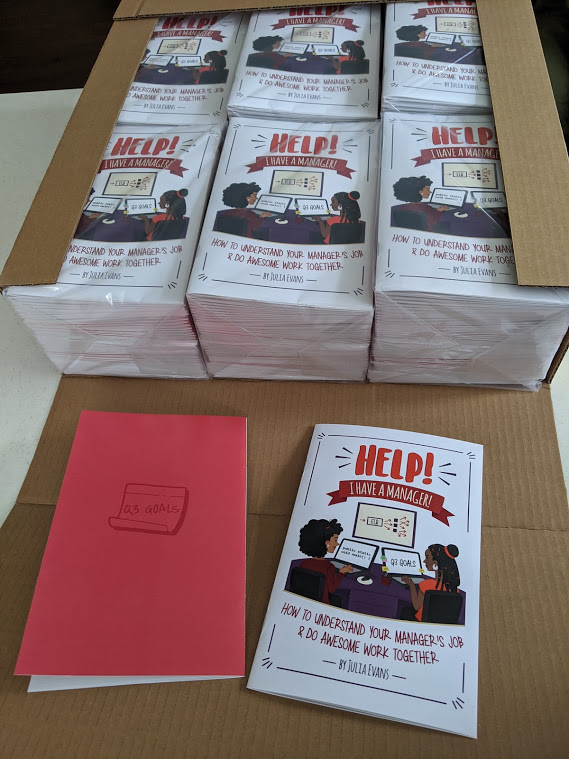
I experimented with a few different print shops in Montreal, and I found out that using a print shop that cost more got me way better quality zines! So that’s what I did. (I went with Photosynthèse).
why I’m shipping them myself
I spent a bunch of time looking into fulfillment companies to try to ~scale~ printing & shipping zines. That research might still come in handy if this first batch goes well (I probably won’t keep doing it myself forever!), but in the spirit of flintstoning, I decided it would be a lot simpler to start out by not overengineering the process. Shipping a zine to the US from Canada using letter mail only costs about $3, so I can even include free shipping.
I’ve actually shipped 100 zines once before in an indiegogo campaign I ran in 2016, and it wasn’t too bad, so I’m confident that I can ship 400 zines manually as long as I can do it all in one giant batch. That time I even wrote all the addresses by hand, which I definitely won’t do this time.
And doing it myself means I can do some fun things with the envelopes & my laser printer that would be hard to convince a fulfillment company to do.
FAQ
Here’s a FAQ which will hopefully answer all your questions! Email me at print@wizardzines.com if you have other questions.
What’s included?
You’ll get:
- A print copy of Help! I have a manager!, printed in full colour on high quality paper.
- A PDF copy of Help! I have a manager! (which usually costs $10 on its own).
What’s the order deadline?
The deadline to order a zine is September 6.
When will I get it?
I’ll mail all the zines around September 7-8, 2020 (right after orders close).
You should get your zine about a week later, assuming the mail system behaves.
Will I get a tracking number?
No. All the zines will be shipped by first class letter mail from Canada, without any tracking. This keeps shipping costs down so that I can do free shipping :). If anything at all goes wrong with your shipment, just let me know (print@wizardzines.com) and I’ll mail you another one. (it’s like UDP!)
The zines should reach the US in about a week, longer if you’re overseas.
Can I order more than one copy at a time?
No, to keep things simple, I’m only shipping one zine at a time. I’m hoping to do batches in the future though!
Can I order these for my team?
Yes! You’ll just need to make one order per person, so that I get everyone’s shipping address. This is extremely compatible with remote work :)
also, if you want to order 50 or more print copies mailed to a single address, email me and we’ll work something out
What happens if I don’t order by September 6?
If this print run sells out, we’ll print more in the future!
What if I already bought the digital copy?
If you already bought the digital copy – thank you!! You can email me at print@wizardzines.com and I’ll send you a discount code to get the print version for less.
What are your future print plans?
If this print run goes well, I’ll figure out how to scale the process up beyond “let’s ship 400 zines from my house”. I’m not sure how that will work yet, but we’ll figure it out!
here’s the link again!
Here’s the link to order a print copy, again! If you just want the PDF, you can get it here: Help! I have a Manager! PDF.
Implementing 'focus and reply' for Fastmail with JMAP
Last month I switched my email to Fastmail. One fun thing about Fastmail is that they built a new protocol called JMAP which is much easier to use than IMAP. So over the last couple of days I built a fun tiny email feature for myself to use with JMAP.
The point of this post is mostly to give a simple end-to-end example of how to use the JMAP API becuase I couldn’t find a lot of examples when I was figuring it out. Here’s the github repo and a gist which shows how to authenticate & make your first request.
cool feature from Hey: focus & reply
I tried the https://hey.com email service for a little bit when it came out. It wasn’t for me, but I liked their “focus and reply” feature. Here’s a screenshot of what it looks like (from a video on their marketing site page for the feature)
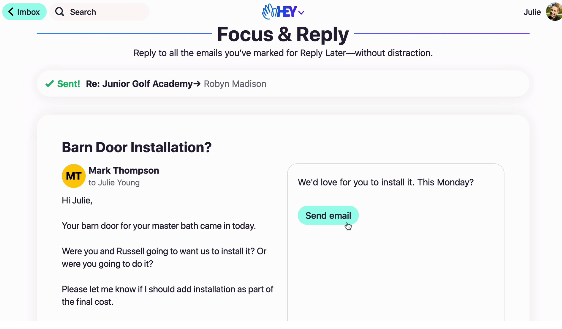
Basically it makes replying to a lot of emails in a batch a little simpler. So I thought – can I use JMAP to implement this focus & reply feature from Hey?
step 0: make the feature simpler
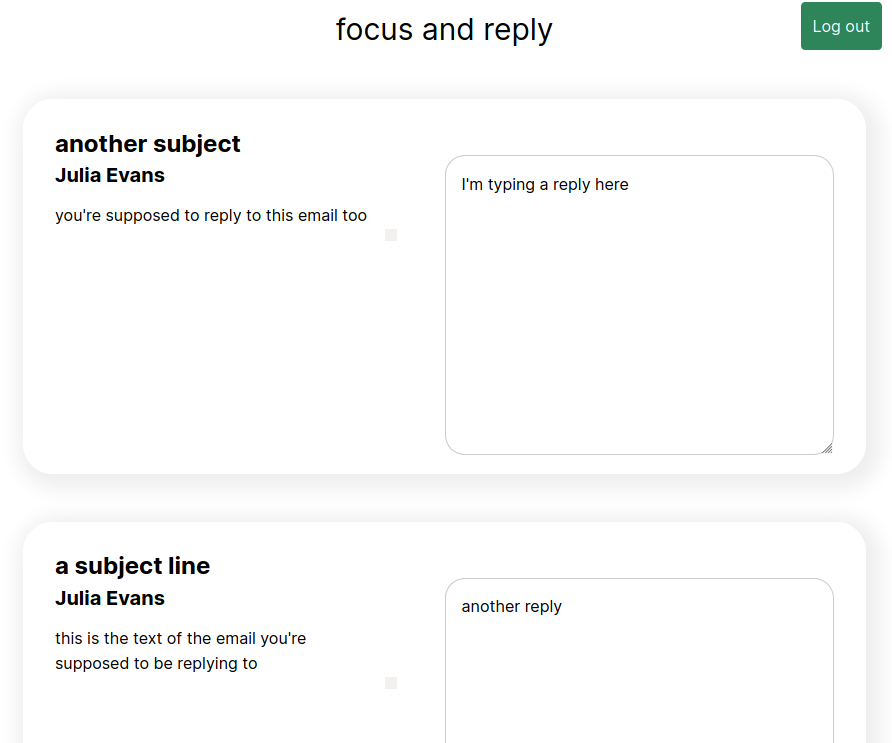
I was a bit too scared to actually send email to start (read-only is safe!), so I decided to start by just making a UI that would show me all the emails I needed to reply to and give me a text box to fill in the replies. Then I could copy and paste the replies into my webmail client to send them. This is a little janky, but I don’t mind it for now.
Here’s an example of what that looks like:
step 0.5: have a “Reply Later” folder in Fastmail
I already had a folder named “Reply Later” in Fastmail, where I manually filed away emails that I needed to reply to but hadn’t gotten to yet. So I had a data source to use! Hooray. Time to start coding.
step 1: get started with JMAP
I couldn’t find a quickstart guide for using JMAP with Fastmail and I was confused about how to do it for quite a while, so part of my goal with this blog post is to give an example of how to get started. I put all the code you need to make your first API request in a gist: fastmail-jmap-quickstart.js
You can authenticate all your requests with HTTP Basic authentication with your username and a Fastmail app password.
Here’s the basics of how it works.
- Make a GET request to https://jmap.fastmail.com/.well-known/jmap. This gives
you a “session” in response, gives you your account ID. You need
this account ID for all the other API calls. I found this a bit surprising
because I usually expect things in
.well-knownto be static files, but this one is a dynamic endpoint that you authenticate to with HTTP Basic authentication. (using your email / app password) - Use that account ID to make requests to the JMAP API at https://jmap.fastmail.com/api/
One thing that threw me off about JMAP at first is that you have to wrap all your API requsts with
{
    "using": [ "urn:ietf:params:jmap:core", "urn:ietf:params:jmap:mail" ],
    "methodCalls": YOUR_REQUEST_HERE
}
For example, this is a request to get a list of all your mailboxes (folders). I think "0" is the ID of the request:
{
    "using": [ "urn:ietf:params:jmap:core", "urn:ietf:params:jmap:mail" ],
    "methodCalls": [[ "Mailbox/get", {
        "accountId": accountId,
        "ids": null
    }, "0" ]]
}
The API wasn’t that intuitive at first, but I was able to figure how to do what I wanted to by reading the spec at https://jmap.io.
step 2: get all my emails
Here’s the query I used to get my emails from JMAP. I basically just copied this from the examples in the JMAP documentation, but I think it’s interesting that it’s not just 1 query, it’s actually 5 different chained queries that build on top of each other. For example, you have:
[ "Email/query", {
    "accountId": accountId,
        // todo: actually do the reply later thing
        "filter": { "inMailbox": mailbox_id },
        "sort": [{ "property": "receivedAt", "isAscending": false }],
        "collapseThreads": true,
        "position": 0,
        "limit": 20,
        "calculateTotal": true
}, "t0" ],
[ "Email/get", {
    "accountId": accountId,
    "#ids": {
        "resultOf": "t0",
        "name": "Email/query",
        "path": "/ids"
    },
    "properties": [ "threadId" ]
}, "t1" ],
...
This queries for a list of all the email IDs in a specific mailbox (my “reply
later” mailbox), calls it t0, and then uses the results of t0 to request
all of those emails.
One of the big ideas in JMAP seems to be this chaining – it really reduces latency if you can do all your work in a single request.
step 3: render the emails!
Once I had all the emails, rendering them was pretty easy – I just used vue.js + Tailwind. The whole thing came out to 170 lines of not-particularly-well-organized Javascript.
the results
It works! It’s already helped me reply to some emails. The github repo is https://github.com/jvns/focus-reply-fastmail.
there are at least 2 problems with this code (and probably more):
- it’s storing passwords in local storage, which I think is not a good security practice.
- it had some XSS vulnerabilities, which I think I’ve finally fixed by putting
the plaintext email in a
<pre>(so that newlines come through) and escaping any HTML entities in there. (<pre>{{email}}</pre>, in Vue)
fastmail seems to use JMAP in a different way than this
I got curious so I used the Network tab to look at how Fastmail’s web interfaces uses jmap.
- Fastmail’s webmail interface doesn’t seem to use https://jmap.fastmail.com/ – instead it uses https://www.fastmail.com/jmap/api. Maybe it’s just a proxy they use so that the requests are being made to the same origin? Unclear.
- It also authenticates in a different way, using
Authorization: Bearer. It seems like this might be a better way to authenticate, but I haven’t found any information about how to get aBearerauthentication like this to use instead of using an app password. - The requests it sends are sometimes compressed with deflate for some reason (instead of gzip), which I guess is fine but it means it’s impossible to look at them in dev tools because Firefox doesn’t understand deflate. Weird!
some links to resources
- JMAP crash course (which I only found after I’d already finished doing this but looks very useful!)
- Fastmail has some JMAP sample code on github
- https://jmap.io/ for the specs
- https://github.com/cure53/DOMPurify is an HTML sanitizer which looks useful for preventing XSS
this seems like a fun way to do email experiments!
I think the idea that anyone can just use JMAP to make fun email UI experiments without dealing with the Hard Parts of email is really fun!
And it’s really cool that I could get this to work 100% as a frontend app, without any server code at all! All the email data is accessible via JMAP, so it seems extremely possible to just do everything with JMAP requests from the client.
Some possible future zines
Hello! I’ve been thinking about what zines I want to write in the future a bit. Usually I don’t have any plans for what I’m going to write next, but having no plan at all feels like it might be getting a bit old.
So this post is mostly a way for me to try to organize my thoughts about why I choose certain topics and what I might want to write in the future.
the criteria
I’m interested in writing about things that are
- fundamental in some way
- very useful to know in your programming job
- stable (the basics of SQL / git / CSS / HTTP / Linux aren’t going to change any time in the next 5-10 years!)
- possible to learn the basics of quickly
There are a LOT of topics that fit these criteria. As I was thinking about topics, I realized that there are lots of topics (like object oriented programming principles) that I think could in theory be pretty valuable but that just didn’t speak to me. What’s up with that?
I only write about topics that I care about
I think a thing that I was missing was – I only write about topics that I really think are exciting and fun and important and want to share with people. Some topics I have kind of a weird and complicated love for, like containers (why are they so weird?!).
And right now I’m writing about CSS, which I’m only learning how to love pretty recently.
I think it’s often important for me to write about topics which I now love but in the past did not love. For example, it took me a very long time to understand how to use tcpdump, and once I got it I felt like I had to tell everyone HELLO I FIGURED IT OUT TCPDUMP IS ACTUALLY AWESOME AND NOT THAT HARD.
It feels a lot less interesting to write about topics where it was immediately obvious to me why they were great or which were easy for me to learn.
zines that I might write
- shell scripting
- debugging (I have 70% of a debugging zine!)
- testing
- more linux internals
- C basics
- gdb
- binary, character encodings, binary formats
- how git works
- TLS certificates, CSRs, CAs, etc.
- profiling
- data structures: graph theory / binary trees / hashmaps
- the Python standard library and/or fun Python basics
- pandas and/or numpy (though I think maybe the pandas cookbook is a better medium for that than a zine)
- machine learning (maybe just logistic regression?)
and a few that I think might be too small or too big for a zine:
- Rust (too big!)
- DNS (maybe a mini zine one day? I really love DNS & dig!)
zines that I don’t think I can write
Here are some topics for zines that I think are “fundamental” in the same way and that I think could be really cool. I don’t think that I could write these today, either because I don’t know enough about the topic yet or because I don’t really feel enough love for it yet.
As with most things, the only way I’ll probably learn more about these is if I end up using them more.
- web accessibility
- postgres (transactions etc?)
- x86 assembly
- hashing (bcrypt, sha-1, md5, etc)
- encryption
- JVM internals
- code review
- kubernetes
- websockets (is there enough to write a whole zine about websockets? I don’t know!)
- functional programming / object oriented programming
- ‘big data’ topics (hadoop, data warehouses, etc)
- paxos or raft
- how search works (like elasticsearch)
- how databases work
that’s all!
I’m still not sure (even after doing this for years!) why it’s so hard for me to tell what topics will make for a good zine that I can write. Maybe one day I will figure it out!
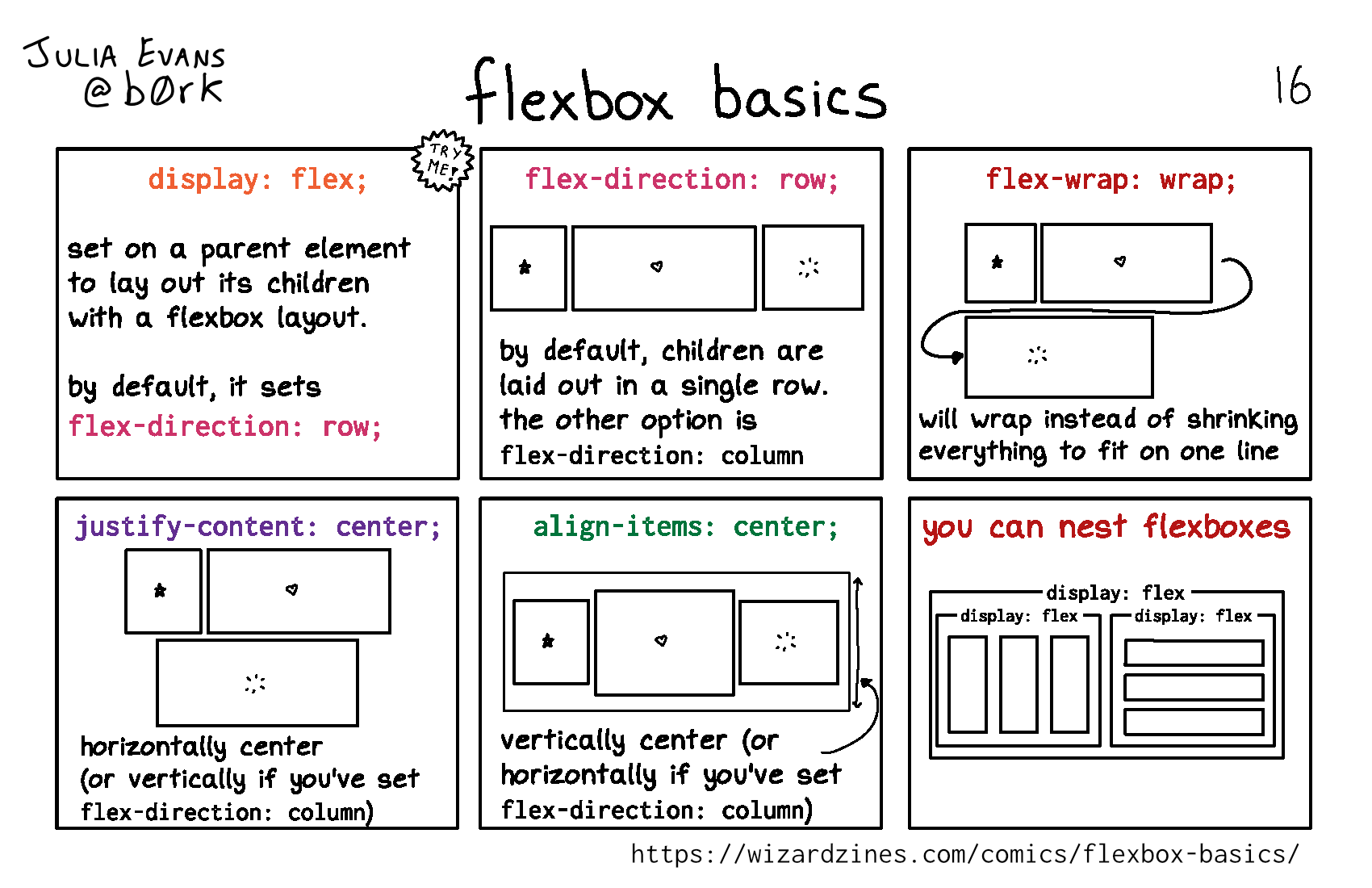
Some more CSS comics
I’ve been continuing to write pages about CSS! Here are 6 more.
Two of them are about how to think about CSS in general (“CSS isn’t easy” and “backwards compatibility”), which is something I’m still trying to wrap my head around.
handling browser bugs is normal?
The fact that finding workarounds for browser bugs is kind of a normal part of writing CSS really surprised me – there’s this great repo called flexbugs which catalogs bugs in browser implementations of flexbox. A lot of the bugs are in IE which means (depending on your goals) that you can just ignore them, but not all! A bunch of the flexbugs are in Chrome or Safari or Firefox.
For example, I ran into flexbug #9 a few days ago, which is
that in Safari a <summary> element can’t be a flexbox, so instead you need to
put an extra div inside the <summary> to be the flex element.
In the past I would have reacted to this in a more grumpy way (WHY? NOOOOO? WHAT IS HAPPENING?!?! CSS?!?!?!). But this time I noticed that my site looked weird in Safari on my iPad, figured out after 30 minutes or so that it was a Safari bug, implemented a workaround, and it actually wasn’t that big of a deal!
I think this mindset of “oh, there’s a browser bug, oh well, I guess that happens sometimes!” is a lot healthier and more likely to result in success than getting mad about it.
there are a lot of ways CSS can go wrong
I think there are at least 3 different ways your CSS can be buggy:
- that element doesn’t have the styles applied that it should (for example
it’s supposed to be
background; bluebut it’sbackground: redinstead) - the element has the “right” styles applied, but those styles do something confusing / unexpected to me because of something I misunderstood about the CSS spec
- the element has the “right” styles applied and those styles do the right thing according to the spec, but the browser has a bug and isn’t implementing the spec correctly
Anyway, enough CSS musings, here are the comics :)
css isn’t easy
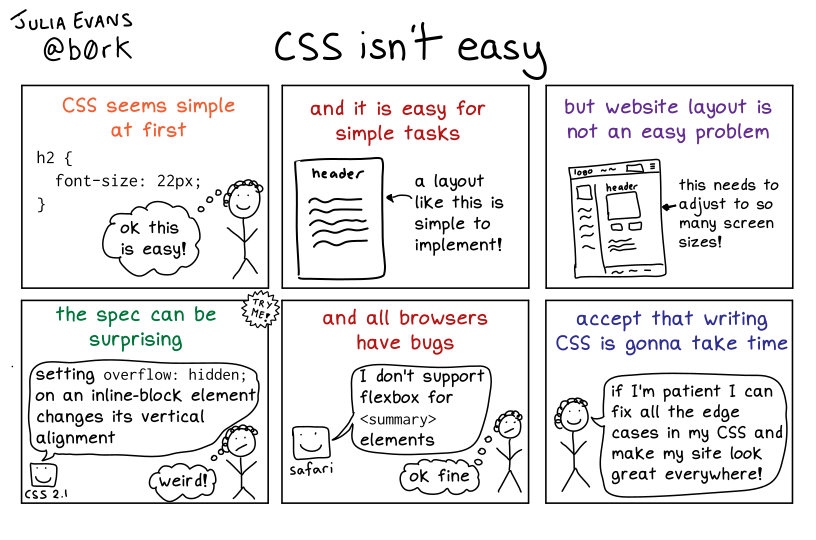 Permalink: https://wizardzines.com/comics/css-isnt-easy
backwards compatibility
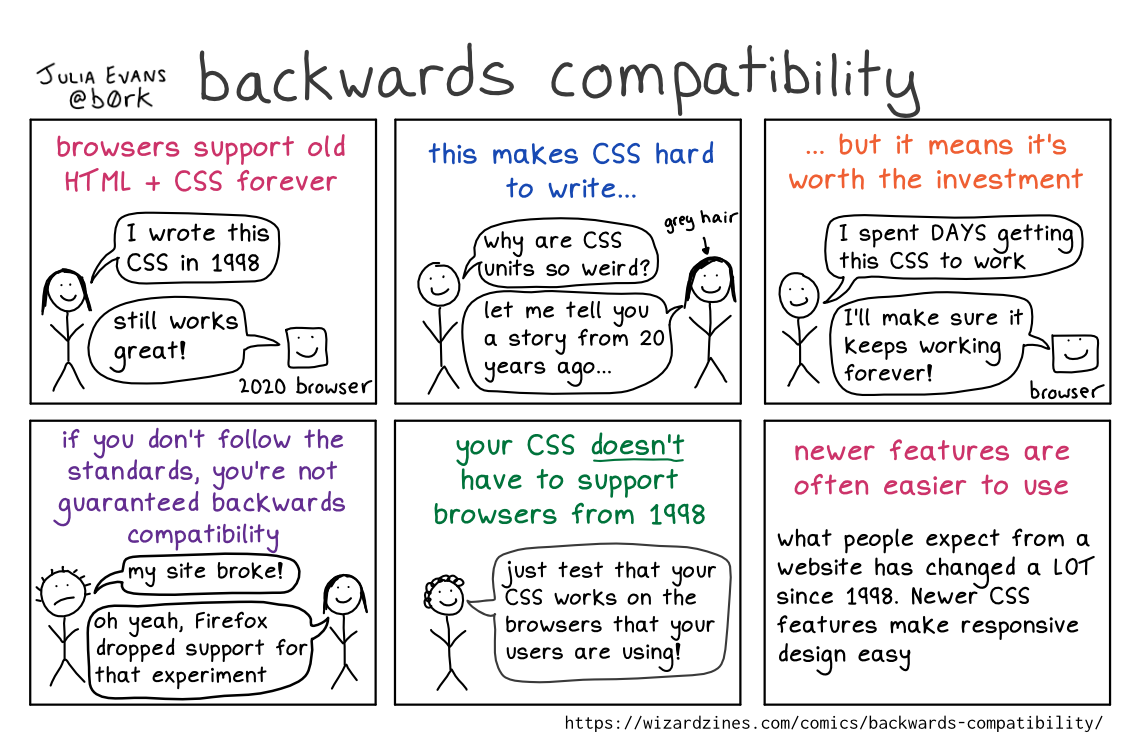 Permalink: https://wizardzines.com/comics/backwards-compatibility
CSS specificity
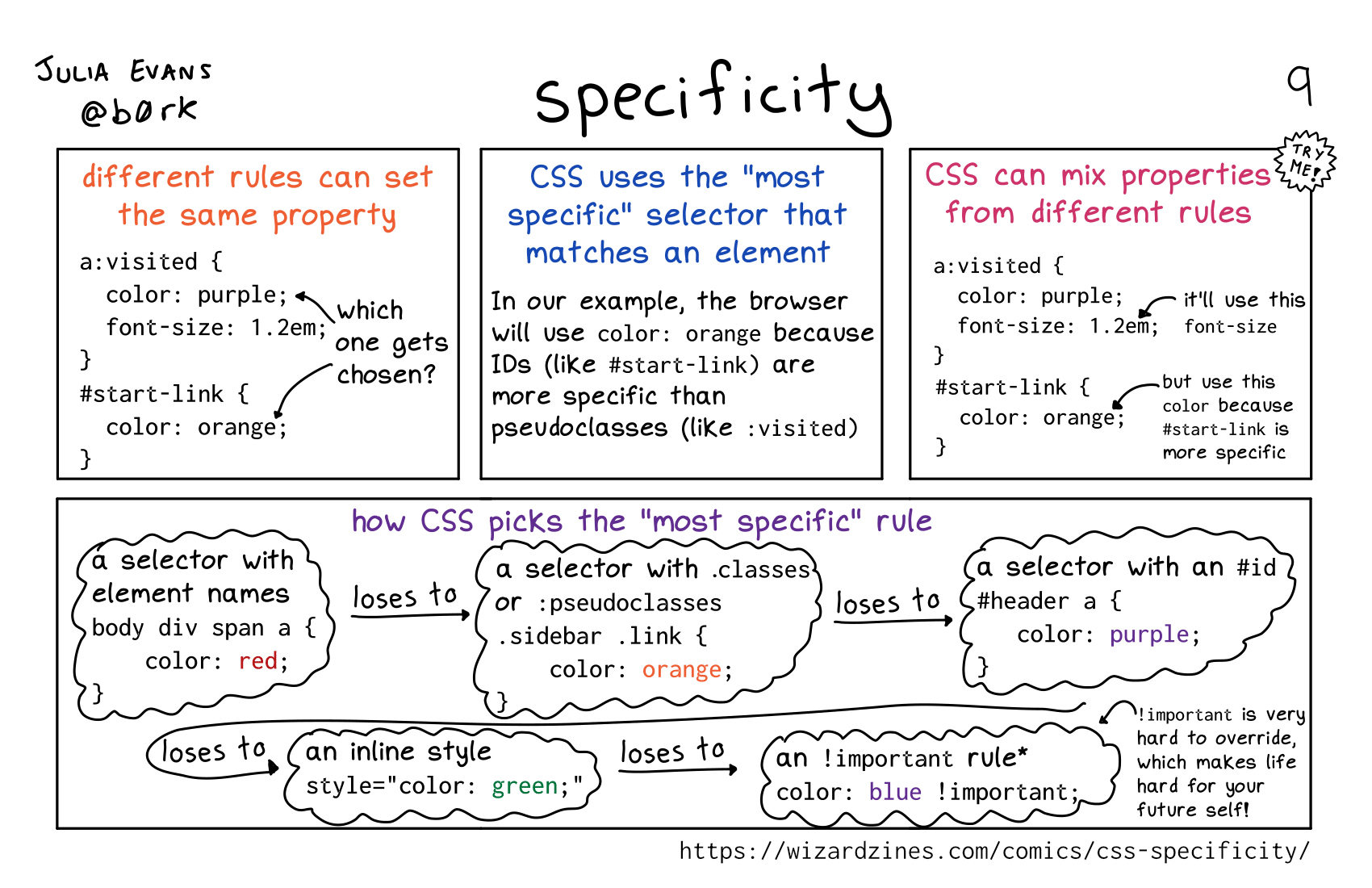 Permalink: https://wizardzines.com/comics/css-specificity
centering in CSS
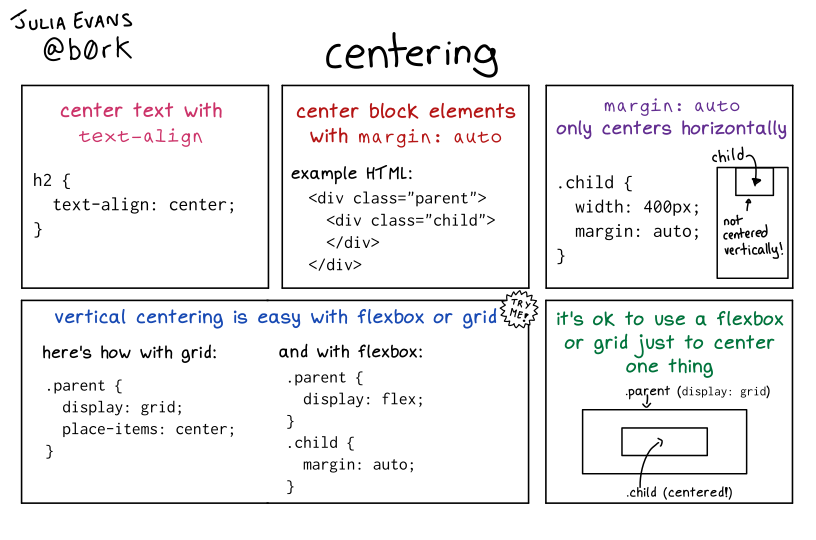 Permalink: https://wizardzines.com/comics/css-centering
padding syntax
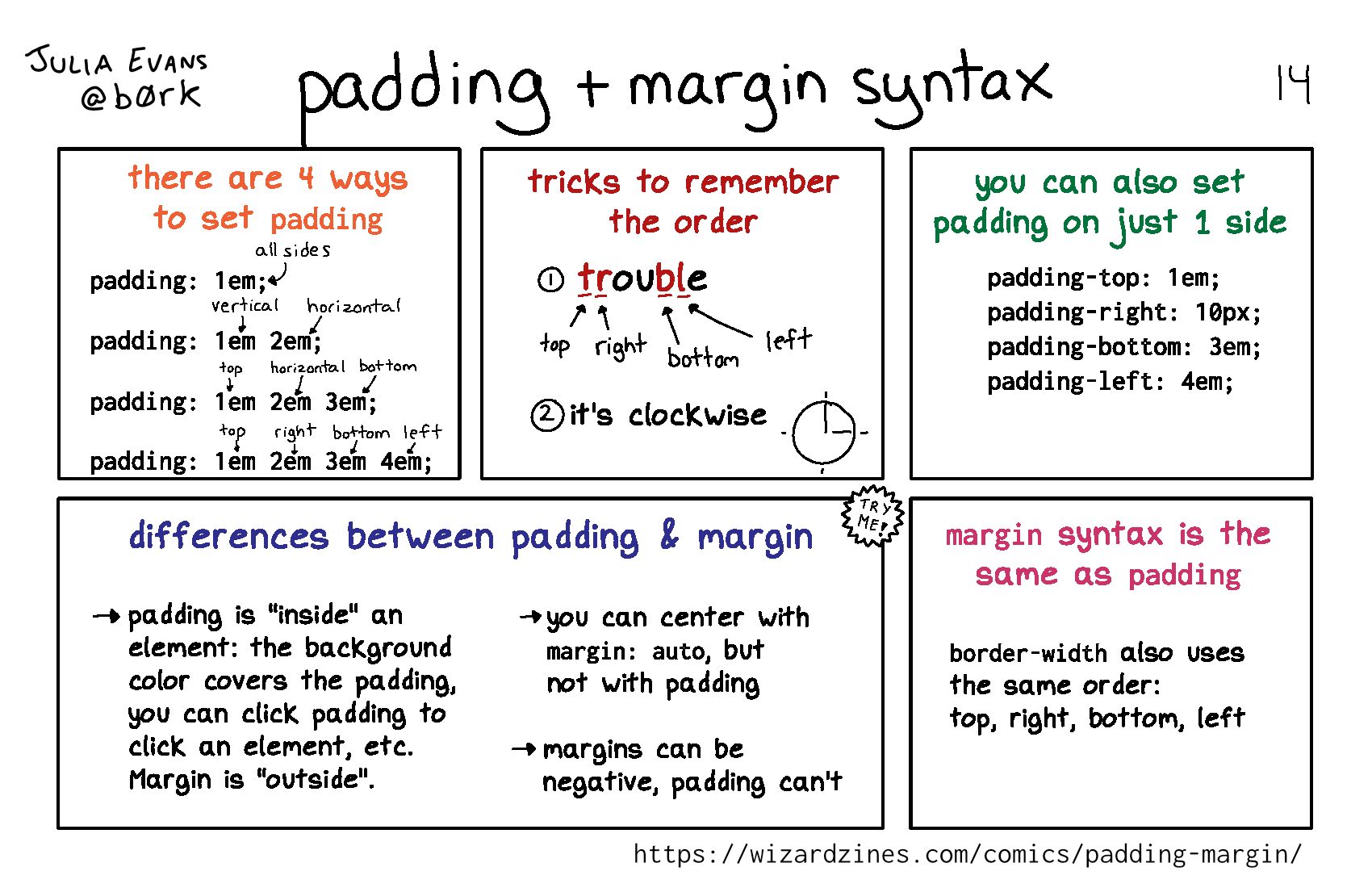 Permalink: https://wizardzines.com/comics/padding-margin